
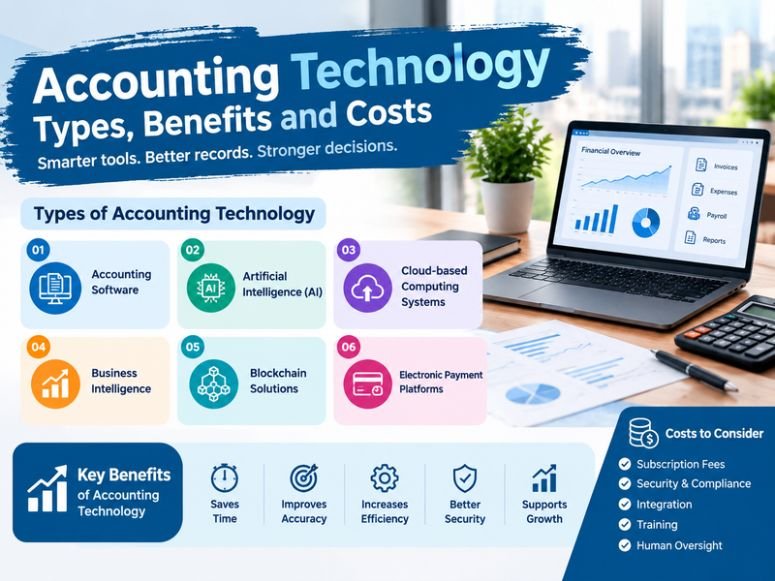
Accounting technology helps businesses manage financial records, process transactions, prepare reports and make informed decisions. Modern tools use software, automation, cloud computing and AI to reduce repetitive tasks and improve access to financial data.
Businesses of different sizes use digital accounting systems to organize invoices, monitor expenses, manage payroll and maintain accurate records. The right technology can simplify everyday accounting tasks while helping teams work more efficiently.
However, choosing accounting technology requires more than comparing software features. Businesses also need to consider subscription costs, security, integration, employee training and the level of human oversight required.
What Is Accounting Technology and How Does It Work?
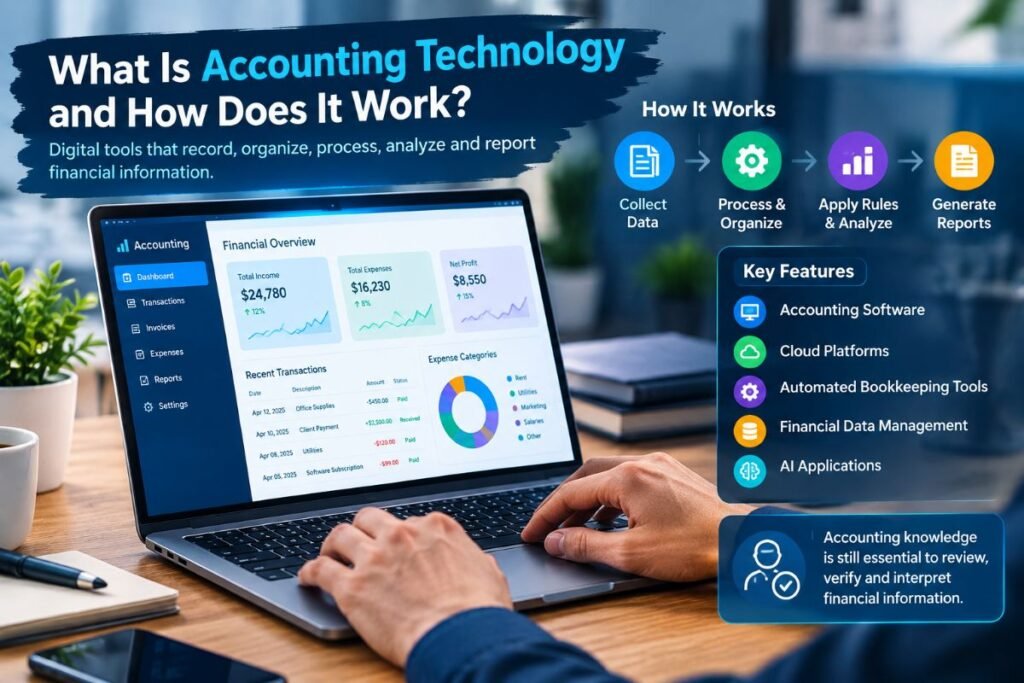
Accounting technology refers to digital tools and systems used to record organize, process, analyze and report financial information. It includes accounting software, cloud platforms, automated bookkeeping tools, financial data management software and artificial intelligence applications.
These systems collect financial data from sources such as bank transactions, invoices, receipts, payroll records and sales platforms. Depending on the software, information may be imported automatically or entered manually by employees.
The technology then organizes transactions, applies accounting rules and produces records or reports. For example, accounting software can categorize business expenses, track unpaid invoices and prepare a profit and loss statement using recorded financial information.
Accounting technology does not eliminate the need for accounting knowledge. Employees and accountants still need to review unusual transactions, verify records, interpret reports and ensure that financial information is complete and appropriate.
What Are the Different Types of Accounting Technology?
Different technologies support different accounting activities. Some focus on everyday bookkeeping, while others help organizations analyze financial performance or connect multiple business systems.
Accounting Software and Automated Bookkeeping Tools
Traditional accounting software helps businesses record income, track expenses, manage accounts payable and receivable and prepare financial statements. Automated bookkeeping tools can import bank transactions, categorize expenses and flag entries that need review.
These features reduce repetitive data entry and make financial records easier to organize. However, automatic categorization should be checked when transactions are unusual or unclear.
Cloud Based Accounting Technology
Cloud based accounting technology stores financial information on online platforms that authorized users can access through the internet. It allows business owners, accountants and finance teams to work with shared records without relying entirely on one office computer.
Cloud systems may also support automatic backups software updates and connections with other business applications. Their actual capabilities depend on the provider, subscription and configuration.
Accounting Workflow Automation
Accounting workflow automation uses software rules to complete routine activities with less manual intervention. Examples include sending invoice reminders, routing expense claims for approval, scheduling recurring invoices and notifying employees about overdue payments.
Automation can make processes more consistent, but poorly configured rules may repeat mistakes. Businesses should test workflows and establish procedures for handling exceptions.
Artificial Intelligence and Financial Analytics
AI in accounting can support transaction categorization, document extraction, anomaly detection and financial forecasting. Analytics tools help users identify spending patterns, compare budgets with actual results and review financial performance.
These systems can speed up analysis, but their suggestions are not always correct. Accountants should verify important outputs before using them for reporting or business decisions.
Accounting Information Systems and ERP Software
Accounting information systems collect and manage financial data for recording, processing and reporting. Enterprise resource planning (ERP) systems can connect accounting with purchasing, inventory, sales, payroll and other business operations.
These integrations reduce the need to transfer the same information between separate applications. However, larger systems may require more planning, training and technical support.
What Are the Benefits of Accounting Technology?
Accounting technology can improve the way businesses manage financial information when systems are selected and maintained properly.
Greater efficiency: Automation reduces time spent on repetitive activities, including transaction entry, invoice reminders and routine reconciliations.
Improved accuracy: Standardized processes and validation rules can reduce common data entry mistakes. Accuracy still depends on reliable source documents and proper review.
Better financial visibility: Digital financial reporting helps business owners monitor income, expenses, cash flow and outstanding payments. Updated records make it easier to identify issues before they become more difficult to manage.
Easier collaboration: Cloud platforms allow authorized team members and external accountants to access shared information. This can reduce delays caused by exchanging multiple versions of spreadsheets and documents.
More informed decisions: Financial reports and analytics help businesses evaluate costs, compare performance with budgets and plan future spending.
Improved organization: Centralized records make it easier to retrieve invoices, review transactions and prepare information for tax or audit requirements.
These benefits depend on the quality of the software, the accuracy of the data and the way employees use the system.
How Does Accounting Technology Improve Everyday Business Processes?
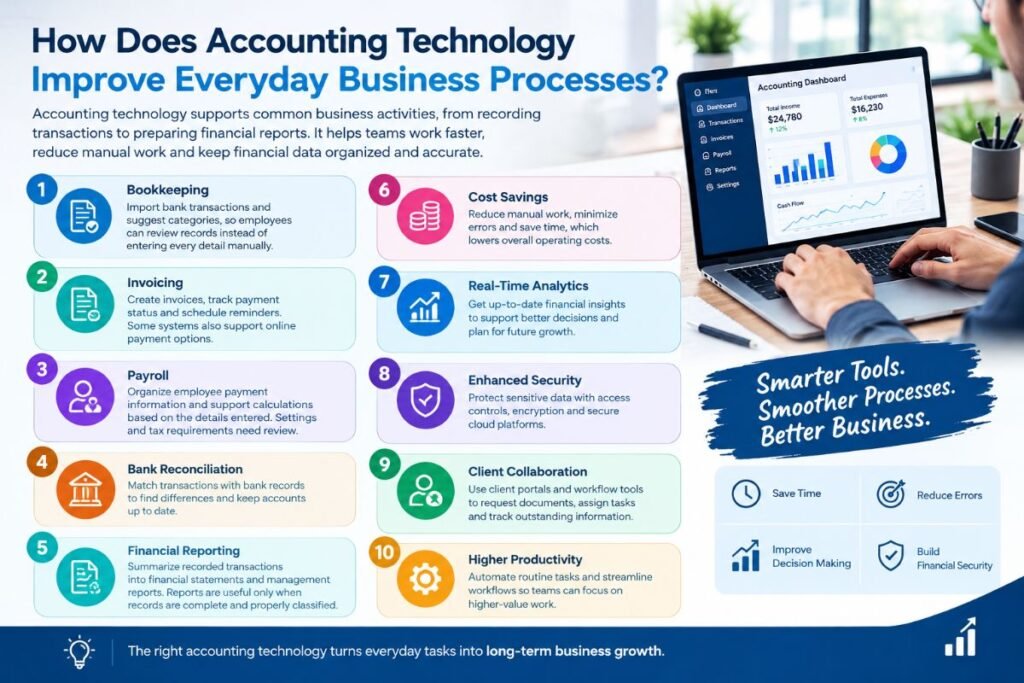
Accounting technology supports several common business activities, from recording transactions to preparing financial reports.
For bookkeeping software can import bank transactions and suggest categories, allowing employees to focus on reviewing records instead of entering every detail manually.
For invoicing, businesses can create invoices, track payment status and schedule reminders. Some systems also support online payment options, helping teams monitor outstanding balances.
For payroll, integrated software can organize employee payment information and support calculations based on the details entered. Payroll settings and applicable tax requirements still need careful review.
For reporting, accounting systems can summarize recorded transactions into financial statements and management reports. These reports are useful only when the underlying records are complete and properly classified.
Accounting firms may also use client portals and workflow tools to request documents, assign tasks and track outstanding information. Clear workflows can reduce delays and improve communication between accountants and clients.
Which Accounting Technology Is Best for Different Businesses?
The best accounting technology depends on business size, transaction volume, reporting needs and available resources.
Freelancers often need straightforward invoicing, expense tracking and income reporting. A simple accounting application may be sufficient if their financial processes are uncomplicated.
Small businesses may benefit from cloud accounting software that combines bookkeeping, bank feeds, invoicing and basic reporting. Growing companies may need inventory management, payroll connections and more detailed financial controls.
Accounting firms often require multi client management, secure document collection, workflow automation and collaboration features. Larger organizations may need ERP systems, role based permissions, advanced reporting and connections with several operational platforms.
Before choosing a system, businesses should identify their essential requirements rather than paying for features they are unlikely to use.
How Much Does Accounting Technology Cost?
Accounting technology costs vary according to the software, number of users, features and complexity of implementation. Basic tools may have low subscription costs, while advanced platforms and ERP systems can require a larger financial commitment.
Businesses should consider more than the advertised monthly price. Additional expenses may include setup, data migration, employee training, integrations, technical support and premium features.
A simple return on investment calculation can help evaluate whether automation is worthwhile. For example, if a tool saves five staff hours each week and the relevant labor cost is $30 per hour, the gross value of the time saved would be $7,800 annually.
If the technology costs $3,000 per year, the difference would be $4,800 before accounting for implementation, training, maintenance and other expenses. This is an illustrative calculation, not a guaranteed saving.
Businesses should compare expected benefits with total ownership costs and review whether the system solves a real operational problem.
How Can Businesses Choose the Right Accounting Technology?
Selecting accounting technology starts with understanding existing accounting processes. Businesses should identify repetitive tasks, reporting problems, recordkeeping gaps and integration requirements before evaluating products.
Important selection criteria include ease of use, essential accounting features, pricing, customer support, security controls and compatibility with existing applications. Companies should also check whether the software supports their reporting requirements and can accommodate expected growth.
Integration deserves particular attention. If accounting software cannot exchange data reliably with payment processors, payroll systems or inventory tools, employees may need to transfer information manually.
Businesses should review trial versions or demonstrations, ask about data export options and understand the provider’s backup and recovery procedures. They should also confirm how user permissions work and whether access can be limited according to job responsibilities.
The best solution is not necessarily the most advanced one. It is the system that meets business needs, fits the available budget and can be used consistently by the people responsible for financial records.
How Should Businesses Implement Accounting Technology?
A structured implementation process can reduce disruption and improve adoption.
First, document current accounting workflows and identify the problems the new system should solve. Next, choose software based on required features, budget, security and integration needs.
Before transferring financial records, clean up duplicate entries and correct obvious errors in the existing data. Plan the migration carefully and verify that opening balances, customer records, supplier details and transaction histories have transferred correctly.
Configure user permissions, approval rules, reporting settings and automated workflows. Test important processes before relying on the new system for everyday operations.
Employees should receive practical training for the tasks they perform. After launch, monitor errors, unresolved transactions and user feedback. Review the system regularly to confirm that it continues to meet business requirements.
How Does Accounting Technology Protect Financial Data?
Financial records contain sensitive information so security must be considered when adopting digital accounting systems. Useful safeguards include multi factor authentication, strong passwords, role based permissions and regular software updates.
Businesses should restrict access to employees who need particular information for their work. They should also maintain secure backups and test recovery procedures instead of assuming that backups will always work correctly.
When choosing a cloud provider, review its security documentation, data handling practices, backup arrangements and available support. Employees should be trained to recognize phishing messages and avoid sharing login credentials.
Integrations also require attention because connected applications may access financial data. Businesses should review third party permissions and remove access that is no longer necessary.
No system can guarantee complete protection. Combining suitable technology with clear internal policies and regular reviews can reduce avoidable risks.
What Are the Disadvantages of Accounting Technology?
Despite its advantages, accounting technology has limitations. Subscription fees, implementation expenses and training requirements may create difficulties for businesses with limited budgets.
Migration errors can affect reports if old records are incomplete or incorrectly transferred. Poorly configured automation can also repeat incorrect classifications or process transactions using unsuitable rules.
Cloud based platforms depend on internet access and provider availability. Businesses may also face integration problems when different applications use incompatible formats or fail to exchange data correctly.
AI tools introduce additional concerns because generated explanations, classifications and forecasts may be inaccurate or incomplete. Important financial decisions should not depend entirely on unverified automated outputs.
Businesses can manage these challenges by testing systems, maintaining backups, training employees and keeping qualified people involved in financial review.
How Is AI Changing Accounting Technology?
AI is expanding the range of accounting tasks that software can support. It can help extract information from invoices, categorize transactions, identify unusual patterns and summarize financial data.
Automation can also reduce manual work in invoice processing, expense management and routine reporting. When connected systems share reliable data, accounting teams may spend less time collecting information from separate applications.
However, AI has limitations. Results can be affected by incomplete records, incorrect source data and system errors. An unusual transaction may be legitimate, while a seemingly normal transaction may still require investigation.
Accountants should review important classifications, reconciliations, forecasts and reports before relying on them. Human judgment remains essential for interpreting context, resolving exceptions and making professional decisions.
What Are the Latest Accounting Technology Trends?
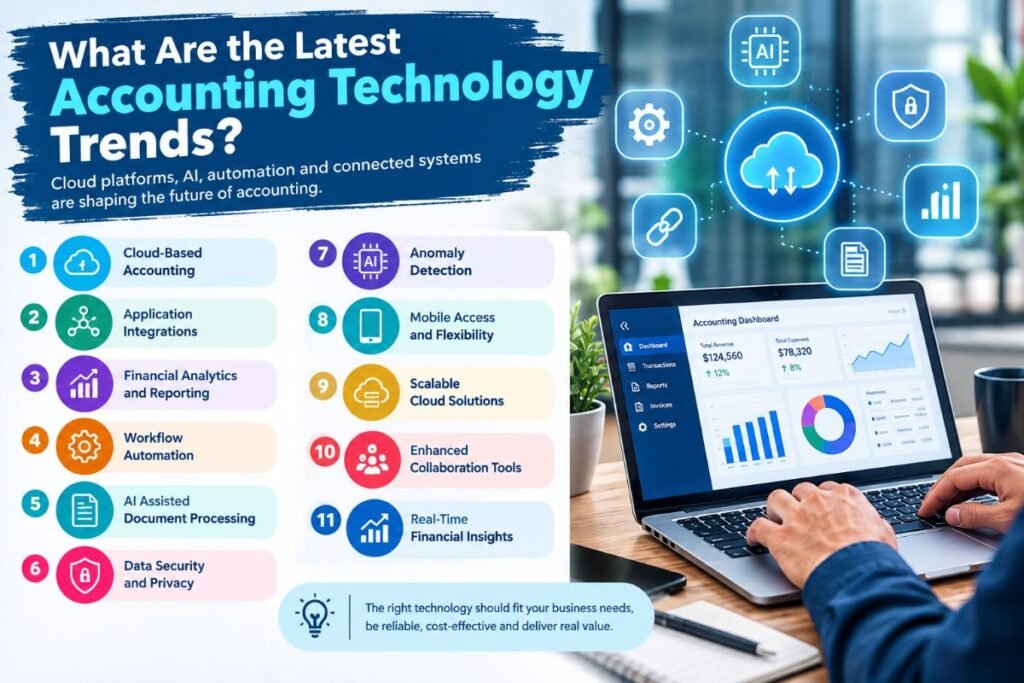
Accounting technology continues to develop through cloud platforms, AI assisted processes, workflow automation and more connected business systems.
Cloud based accounting makes shared access and remote collaboration easier. Application integrations help move information between accounting, payroll, sales and payment systems. Analytics tools support financial monitoring, while automated workflows help teams manage recurring activities.
AI assisted document processing and anomaly detection may further reduce routine work, although results still require appropriate review. Businesses are also placing greater attention on access controls, privacy and the security of connected applications.
The practical value of these trends depends on the organization’s needs. Businesses should evaluate new features according to their reliability, cost and measurable usefulness rather than adopting technology simply because it is new.
For more informative articles and helpful guides on a range of topics, explore the Pepper0 General category.
Conclusion
Accounting technology helps businesses organize financial records, automate routine tasks and access useful financial information. Cloud accounting, automation, integrated systems and AI tools can support more efficient workflows when they match an organization’s needs.
Choosing the right solution requires evaluating features, total costs, security, integration and employee training. Businesses should also verify migrated data, test automated processes and maintain appropriate access controls.
With careful implementation and human oversight, accounting technology can strengthen everyday financial management and help businesses make better informed decisions as their requirements change.
FAQs
What is accounting technology?
Accounting technology includes software and digital systems used to record, process organize, analyze and report financial information. Examples include accounting applications, cloud platforms, automation tools and AI assisted systems.
How does accounting technology improve accuracy?
It can reduce manual data entry, apply consistent rules and flag unusual transactions. However, accurate results still depend on correct source data, suitable configuration and human review.
What is the best accounting technology for small businesses?
Small businesses often benefit from user friendly accounting software with bookkeeping, invoicing, expense tracking, bank connections and basic reporting. The right choice depends on budget and business requirements.
How much does accounting technology cost?
Costs depend on the platform, features, number of users and implementation needs. Businesses should account for subscriptions, training, migration, integrations and ongoing support when comparing options.
Can AI replace accountants?
AI can assist with repetitive accounting tasks and financial analysis, but it does not remove the need for professional judgment. Accountants remain important for reviewing results, interpreting financial information and handling complex situations.
Pingback: Building Technology Types: Methods, Materials and Systems
Pingback: Health Information Technology Income: Salary Guide