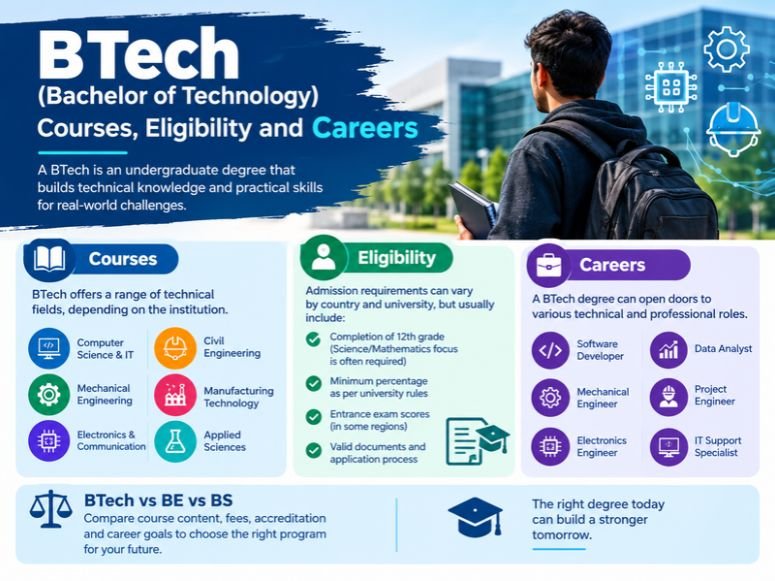
A Bachelor of Technology (BTech) is an undergraduate degree that develops technical knowledge and practical skills. Common fields include computing, engineering technology, electronics, manufacturing and applied sciences, depending on the institution.
A BTech degree program can help students prepare for technical roles by combining classroom learning with laboratory work, projects or industry experience. However, the exact curriculum, admission requirements and professional opportunities depend on the country and university.
Before applying, students should understand the differences between BTech, Bachelor of Engineering (BE) and Bachelor of Science (BS) degrees. Comparing course content, total costs, accreditation and career goals can help them choose a suitable program.
What Is a Bachelor of Technology Degree?
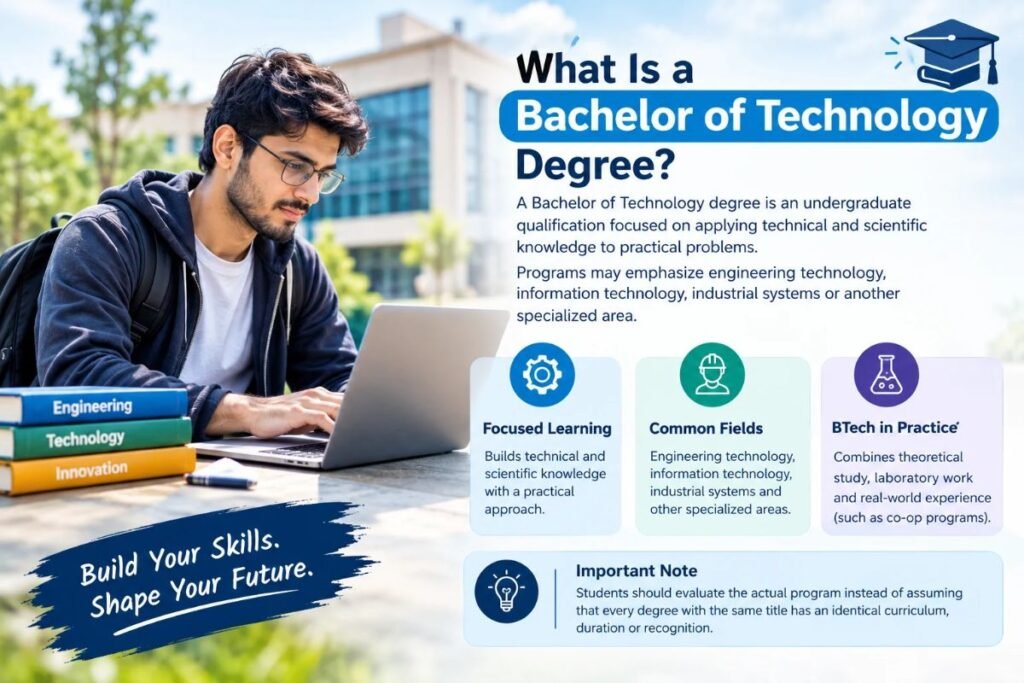
A Bachelor of Technology degree is an undergraduate qualification focused on applying technical and scientific knowledge to practical problems. Programs may emphasize engineering technology, information technology, industrial systems or another specialized area.
BTech usually refers to an undergraduate degree in technology or engineering related fields. For example, McMaster University in Canada combines theoretical study, practical laboratory work and co op experience in its BTech program.
Students should therefore evaluate the actual program instead of assuming that every degree with the same title has an identical curriculum, duration or recognition.
What Are the Bachelor of Technology Courses and Curriculum?
The Bachelor of Technology curriculum depends on the chosen specialization. Most programs combine foundational subjects with advanced technical courses, practical assignments and assessments relevant to the selected field.
Students in computing related programs may study programming, databases, networking and software development. Engineering technology students may encounter mathematics, physics, electronics, technical design and equipment related subjects.
Some programs also include communication, project management, business fundamentals and workplace safety. These subjects can help students explain technical work, collaborate with teams and understand how technology operates within organizations.
Practical learning may involve laboratory experiments, design projects, simulations, workshops, internships or co op placements. Students should check the official course list to determine how much practical experience a particular program provides.
What Are the Eligibility Requirements for BTech?
BTech admission requirements vary according to the country, institution, program and applicant’s previous education. Students should check the official admission page before preparing an application.
In many undergraduate engineering or technology programs, applicants need to complete secondary education or an equivalent qualification. Mathematics and science subjects may be required for engineering focused courses, while computing programs may have different subject expectations.
Some universities consider entrance examinations, academic grades, English language proficiency or other application materials. International applicants may also need credential evaluations, translated documents or proof of language proficiency.
Students with a diploma or previous postsecondary education should check whether transfer credits or advanced standing are available. Approval depends on the institution’s policies, completed subjects and curriculum requirements.
Meeting minimum eligibility requirements does not automatically guarantee admission. Competitive programs may have additional selection criteria or limited places.
How Long Does a Bachelor of Technology Degree Take?
The BTech degree duration depends on the educational system, program structure and previous qualifications. A conventional full time bachelor’s degree commonly takes around three to four years, but this is not a universal rule for every BTech program.
Some programs take longer because they include structured work placements, co op terms or additional academic requirements. Part time study may also extend the time needed to graduate.
Transfer credits can sometimes reduce the remaining study period when a university accepts relevant previous coursework. Accelerated pathways may also be available, but students should confirm the requirements before assuming they can finish early.
When comparing programs, check the total number of academic terms, placement requirements, credit transfer policies and expected graduation timeline.
Which Specializations Are Available in Bachelor of Technology?
Bachelor of Technology specializations allow students to focus on an industry or technical discipline. Availability differs between universities so applicants should review the programs offered by their preferred institutions.
Computer Science and Information Technology: These fields may cover programming, databases software systems, networks, cybersecurity or information management. They can suit students interested in building and maintaining digital systems.
Mechanical Technology: Programs may focus on manufacturing processes, mechanical systems, materials, design and equipment maintenance. Practical work can help students understand how machines and industrial components operate.
Civil Technology: Study may include construction methods, surveying, structural materials, technical drawings and infrastructure projects. Career eligibility can depend on the role, local regulations and professional requirements.
Electrical and Electronics Technology: Students may explore circuits, electrical systems, instrumentation, control systems and electronic equipment. Some programs also include automation or industrial applications.
Automation Systems: This specialization may cover sensors, control systems, robotics and industrial networks. These skills can be relevant to manufacturing, processing and other industries that use automated equipment.
Biotechnology: Some technology focused programs combine biology, chemistry, laboratory techniques and applied engineering. Possible study areas include bioprocessing, analytical methods and quality control.
The best specialization depends on the work a student wants to pursue. Reviewing course descriptions, practical facilities and graduate career pathways is more useful than selecting a field based only on its name.
What Is the Difference Between BTech, BE and BS?
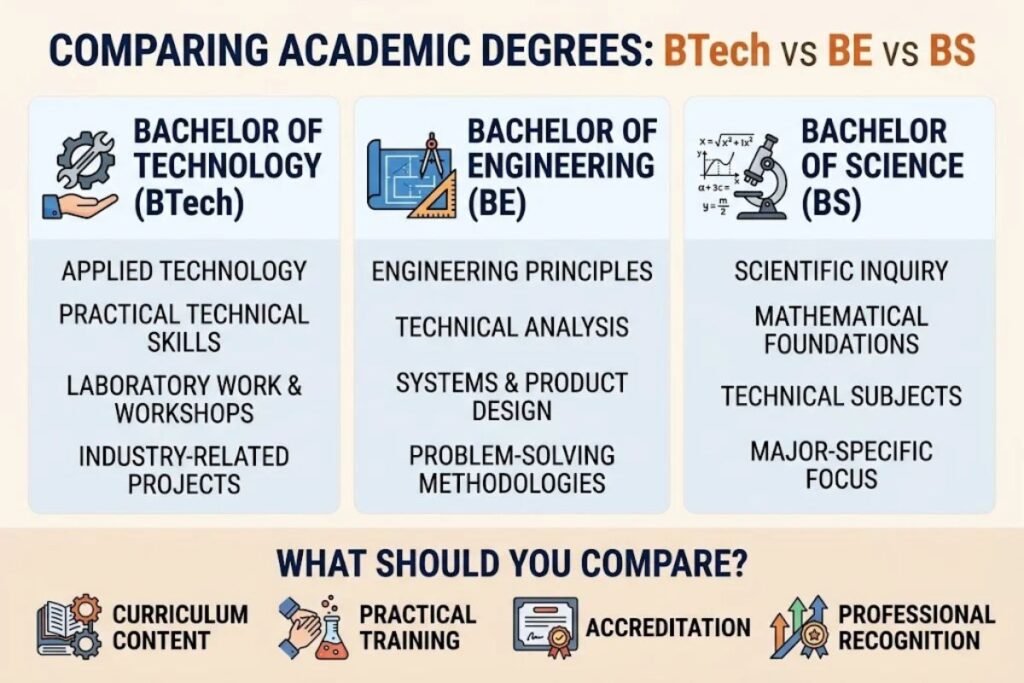
BTech, BE and BS degrees differ in their typical focus, coursework and career pathways, although their exact structure varies by institution and country.
- Bachelor of Technology (BTech): Often focuses on applied technology, technical skills, laboratory work and industry related projects.
- Bachelor of Engineering (BE): Commonly emphasizes engineering principles, technical analysis, design and problem solving.
- Bachelor of Science (BS): Usually focuses on scientific, mathematical or technical subjects, depending on the chosen major.
- Practical Learning: All three degrees may include laboratory sessions, projects and industry placements, depending on the program.
- Career Opportunities: BTech graduates may pursue technical roles, BE graduates engineering related careers and BS graduates careers linked to their selected field.
- Recognition and Accreditation: The value and professional recognition of each degree depend on the institution, program accreditation and relevant professional requirements.
These are general differences, not universal rules. Before choosing a degree, compare the curriculum, practical training, accreditation and professional recognition of specific programs. Students planning to work abroad should also check the qualification requirements of their intended employer or professional regulator.
How Much Does a Bachelor of Technology Degree Cost?
Bachelor of Technology tuition fees vary significantly by country, university, residency status and specialization. There is no single reliable price that applies to every BTech degree.
The total cost may include tuition, application charges, laboratory or equipment fees, books software, accommodation, transportation and everyday living expenses. International students should also check whether different tuition rates or additional administrative requirements apply.
To compare costs accurately, use the university’s official tuition page and identify the relevant academic year. Check whether the published amount covers one semester, one academic year or the entire degree.
Financial aid may include scholarships, grants, bursaries or other institution specific assistance. Eligibility, application deadlines and award amounts differ so students should confirm the conditions directly with the provider.
A practical budget should include the full expected study period rather than tuition alone. This helps students compare programs with different durations and avoid choosing an option that becomes unaffordable later.
What Can You Do With a Bachelor of Technology Degree?
Career opportunities after BTech depend on the specialization, practical experience, technical skills and local employment requirements. The degree can provide a foundation for several technology related pathways, but it does not guarantee a particular job.
Computing graduates may pursue roles such as software developer, IT support specialist, systems analyst or network technician, depending on their training and employer requirements.
Mechanical and manufacturing graduates may explore technical support, production, quality control, maintenance or computer aided design roles. Electrical and automation graduates may seek work involving control systems, testing, instrumentation or industrial equipment.
Civil technology graduates may pursue technical positions connected with construction, surveying or infrastructure projects. Biotechnology graduates may explore laboratory support, quality assurance or bioprocessing roles where their education meets the employer’s requirements.
Some positions require additional licensing, professional registration, certifications or further education. Students should review actual job descriptions in their target location to identify the skills and qualifications employers expect.
Is a Bachelor of Technology Degree Worth It?
A Bachelor of Technology degree may be worthwhile for students whose career goals align with the program’s subject area and practical training. Its value depends on the quality and recognition of the qualification, the total cost and the opportunities available after graduation.
Programs with relevant laboratories, industry projects or structured work experience may help students develop practical skills. However, these features should be verified rather than assumed from the degree title.
Compare the curriculum with entry level job requirements and speak with university advisers about graduate outcomes where reliable information is available. Consider whether the program supports your preferred career, location and future education plans.
The degree may be less suitable if it does not teach the skills required for your intended profession or if the total cost creates an unreasonable financial burden. A careful comparison is more useful than relying on broad claims about the value of any bachelor’s degree.
Can You Earn a Bachelor of Technology Degree Online?
Online bachelor’s programs are available in several technology related fields, including information technology, computer science and software engineering. However, the availability of a fully online program specifically titled Bachelor of Technology depends on the country and institution.
Online study can provide flexibility for students balancing education with work or family responsibilities. It may also reduce the need to relocate, although students still need to consider tuition, equipment, internet access and any required in person activities.
Programs involving physical laboratories, specialist equipment or supervised practical training may require campus attendance or approved placements. Students should check how these requirements are delivered before enrolling.
It is also important to confirm that the institution is recognized and that the program meets the requirements of the student’s intended career. Online delivery alone does not determine whether a qualification is academically or professionally accepted.
How Can You Verify Bachelor of Technology Accreditation and Recognition?
Accreditation and recognition help students evaluate whether a program meets relevant academic or professional standards. Their meaning varies by country and institutional recognition is not always the same as program specific accreditation.
Start by checking the university’s official website and the relevant government or higher education authority. If the intended career is regulated, consult the professional regulator to determine whether the degree satisfies its educational requirements.
For international study, contact the organization responsible for evaluating foreign qualifications in the country where you intend to work or continue studying. Ask whether it assesses the institution, the specific program or both.
Students should also check accreditation status for the correct campus, program title and intake year. Do not rely solely on advertising claims or assume that recognition in one country automatically guarantees acceptance elsewhere.
Can You Pursue a Master’s Degree After BTech?
A BTech graduate may be eligible to apply for a master’s degree, but admission depends on the university, postgraduate program and the applicant’s previous coursework.
Relevant options may include master’s programs in engineering technology, information technology, computer science, management or an applied scientific field. Some programs require specific undergraduate subjects, a minimum academic result, professional experience or additional prerequisite courses.
Students considering postgraduate study should check admission requirements before selecting their undergraduate specialization. If they plan to study internationally, they should confirm how the destination institution evaluates their degree and transcripts.
A bachelor’s degree does not automatically guarantee admission to every master’s program. The receiving university makes the final decision according to its published policies.
Which Country Is Best for Studying Bachelor of Technology?
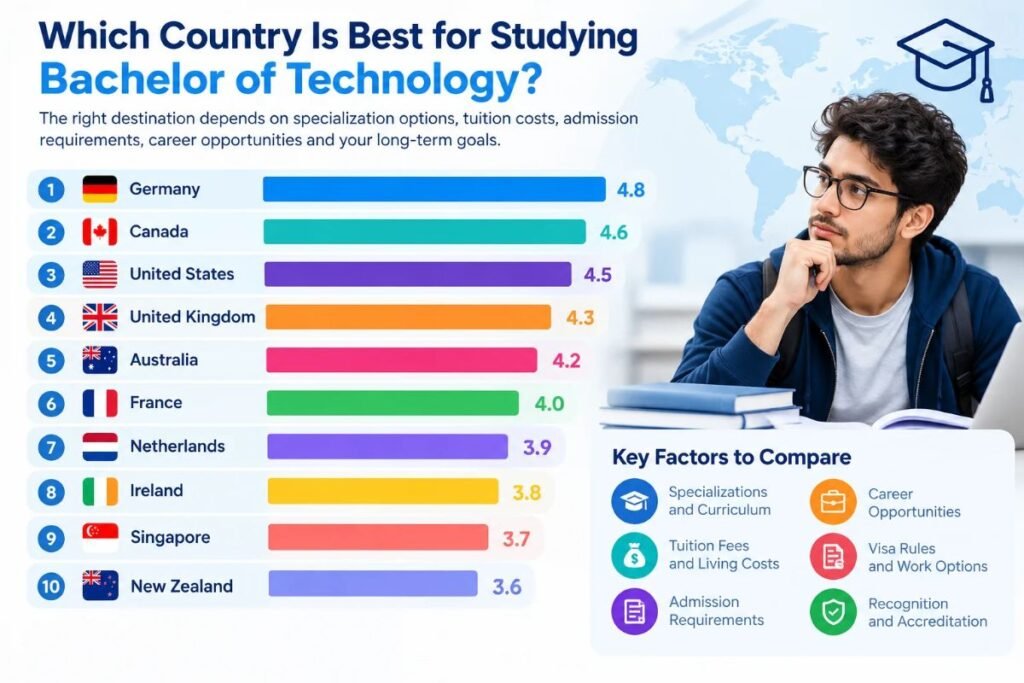
There is no single best country for every BTech student. The right destination depends on the available specialization, tuition budget, admission eligibility, language requirements and career plans.
Students comparing countries should examine official university curricula, accreditation, practical training opportunities and total living expenses. They should also review visa rules and whether international graduates can legally pursue employment after completing their studies.
Recognition is particularly important for students who plan to return home or move to a third country after graduation. Confirming qualification requirements before enrolling can help prevent problems later.
Rather than choosing a country based only on reputation, shortlist specific programs and compare their academic content, costs and suitability for your intended career.
Explore more informative guides and helpful articles on different topics in the Pepper0 General category.
Conclusion
A Bachelor of Technology degree provides an undergraduate pathway into applied technology and related technical fields. Its curriculum, duration, admission requirements and specializations vary by country and institution.
Before enrolling, compare the program’s total cost, practical learning opportunities, accreditation and career relevance. Review official sources carefully, especially when evaluating international recognition or online study options.
The right BTech degree is one that matches your academic background, budget and long term goals. A well informed choice can help you build relevant skills and prepare for suitable employment or further education.
FAQs
Is a Bachelor of Technology the same as an engineering degree?
Not always. Some BTech programs focus on engineering technology, while others have different structures. Compare the curriculum, accreditation and professional recognition before treating two qualifications as equivalent.
Can I study BTech without mathematics?
It depends on the specialization and university. Many engineering related programs require mathematics, while other technology programs may have different subject requirements. Check the official admission criteria.
Can I change my specialization after admission?
Some universities allow students to change programs or specializations, but approval may depend on academic performance, available places and prerequisite courses. Confirm the transfer policy before applying.
Is an online Bachelor of Technology degree accepted by employers?
Acceptance depends on the institution, program recognition, employer requirements and the intended role. Verify accreditation and any professional requirements relevant to your target career.
Can a BTech graduate apply for jobs in another country?
Possibly, but employment depends on the employer, local qualification requirements, work authorization and the graduate’s skills. Regulated professions may have additional recognition or licensing requirements.