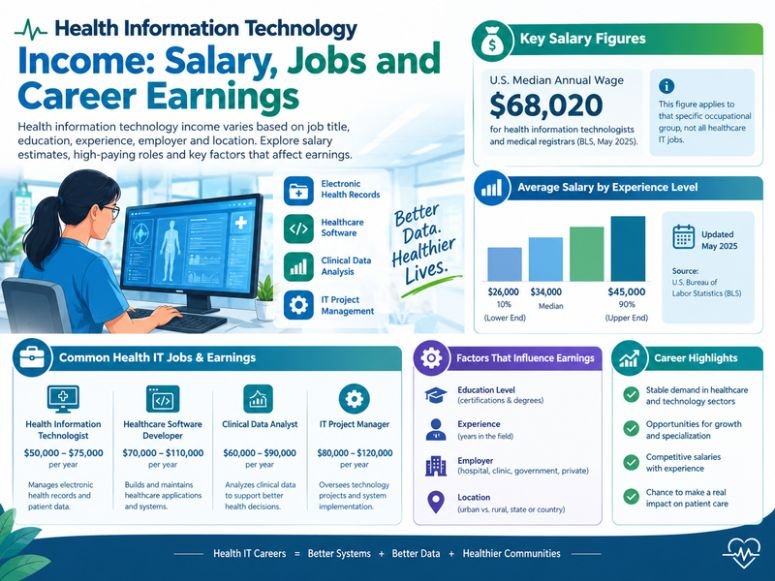
Health information technology income varies according to job title, education, professional experience, employer and location. Some professionals manage electronic health records, while others develop healthcare software, analyse clinical data or oversee technology projects.
In May 2025, the U.S. Bureau of Labor Statistics (BLS) reported a median annual wage of $68,020 for health information technologists and medical registrars. This figure applies to that specific occupational group, not all healthcare IT jobs.
Understanding salary differences can help you choose a suitable career path, evaluate education options and compare job offers. The following guide explains available salary estimates, higher paying roles and the factors that influence health IT earnings.
What Is the Average Health Information Technology Income?
There is no single average salary that accurately represents every health information technology professional. Salary estimates differ because sources may measure different occupations, reporting periods and types of compensation.
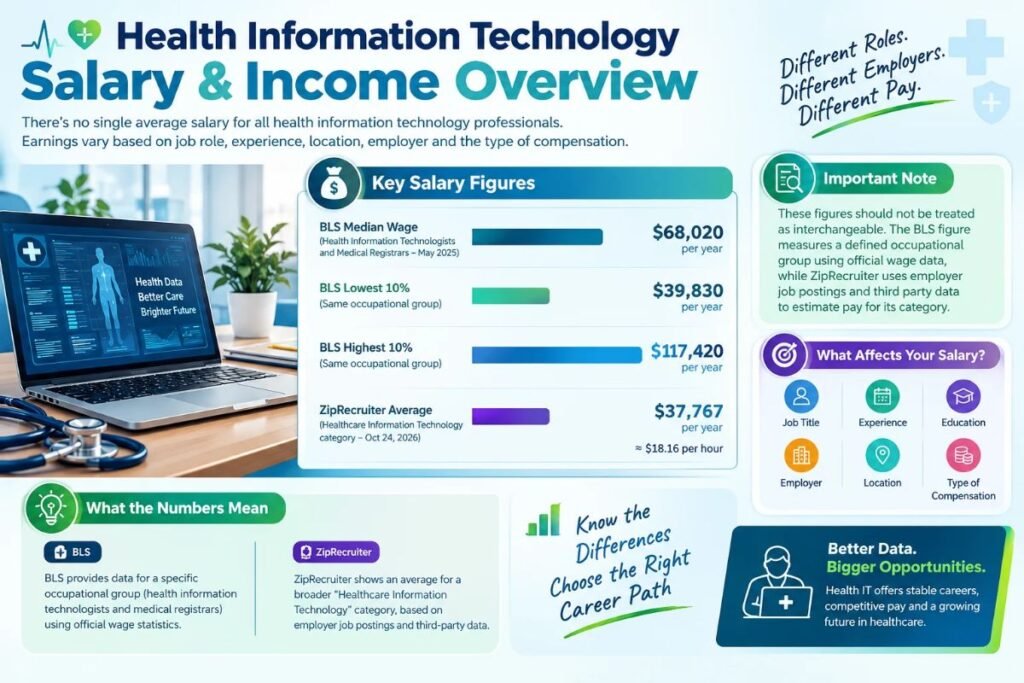
The BLS reported a median annual wage of $68,020 for health information technologists and medical registrars in May 2025. The lowest 10 percent earned less than $39,830, while the highest 10 percent earned more than $117,420.
ZipRecruiter reported an estimated average annual pay of $37,767 for its broader titled “Healthcare Information Technology” category as of October 24, 2026. Its estimate was equivalent to approximately $18.16 per hour, based on its salary calculation.
These figures should not be treated as interchangeable. The BLS figure measures a defined occupational group using official wage data, while ZipRecruiter uses employer job postings and third party data to estimate pay for its category.
Average Salary, Median Salary and Total Compensation
Understanding salary terminology is essential when comparing health information technology earnings. An average salary adds reported earnings and divides them by the number of observations, while a median identifies the midpoint of the reported distribution.
Median pay is useful because very high or low salaries can affect an average. However, a median does not tell you exactly what a particular beginner, specialist or manager will earn.
Total compensation can include base salary, bonuses, commissions, profit sharing and other additional payments. For example, Coursera’s September 8, 2026 salary guide uses Glassdoor based median total pay estimates for several healthcare IT roles.
Always check whether a figure represents base pay, median wages, average pay or total compensation before using it to estimate your potential earnings.
Health Information Technology Income by Job Title?
Health IT salaries vary depending on job responsibilities, qualifications, technical skills and experience. According to Coursera’s September 2026 guide, the following Glassdoor based median total pay estimates illustrate the differences across roles.
- Health Information Technician: $52,000 per year
- Medical Records Technician: $54,000 per year
- Medical Records Administrator: $57,000 per year
- IT Specialist in Healthcare: $68,000 per year
- Information Manager in Healthcare: $71,000 per year
- Health Informatics Specialist: $98,000 per year
- Healthcare System Administrator: $127,000 per year
- Health IT Project Manager: $138,000 per year
- Healthcare Technology Consultant: $174,000 per year
- Healthcare Software Developer: $186,000 per year
These figures are source specific estimates, not guaranteed salaries or official BLS medians for every occupation. Actual earnings depend on experience, employer, location and job requirements so compare figures for the specific role you intend to pursue.
Health Information Technician Salary
Health information technicians help maintain organise and analyse healthcare records. Their work may involve checking patient information, supporting electronic health record systems and ensuring that data is accurate and appropriately handled.
Coursera lists a median total pay estimate of $52,000 for health information technicians. The actual salary offered can vary according to employer requirements, location, relevant experience and the precise duties of the position.
This role may suit people interested in healthcare information management without pursuing a software development or senior technology management career.
Medical Records Technician Salary
Medical records technicians work with patient documentation and related information systems. Their responsibilities may include organising records, checking information for completeness and supporting appropriate documentation procedures.
Coursera reports a Glassdoor based median total pay estimate of $54,000 for medical records technicians. Entry requirements differ between employers so candidates should review the education, experience and certification requirements in individual job advertisements.
Medical records technicians should not automatically be grouped with health information technologists. The occupational definitions and responsibilities used by salary sources may differ.
Health IT Specialist Salary
Health IT specialists support technology used by healthcare organisations. Depending on the position, they may help users troubleshoot systems, maintain applications, support electronic health records or assist with system implementation.
Coursera lists a median total pay estimate of $68,000 for healthcare IT specialists. More specialised roles may require technical knowledge, healthcare experience or responsibility for complex systems.
The job title alone does not determine pay. Candidates should compare the required skills, level of responsibility and compensation structure before deciding whether an opportunity offers competitive earnings.
Which Health Information Technology Jobs Pay the Most?
Higher paying health IT positions often involve specialised technical skills, complex projects, consulting responsibilities or leadership. However, salary potential depends on the specific employer, the scope of the role and the candidate’s qualifications.
Coursera’s reported figures place healthcare software developers and technology consultants among the higher paid roles in its comparison. Project management and healthcare systems administration also appear among the positions with substantial reported median total pay.
Healthcare Software Developer
Healthcare software developers create, maintain or improve software used by healthcare organisations. Their work may involve applications that support clinical workflows, administrative operations or the handling of healthcare information.
Coursera reports a median total pay estimate of $186,000 for healthcare software developers. This is a Glassdoor based estimate from its September 2026 guide, not an official median wage for a separately defined BLS healthcare software developer occupation.
The role may require programming skills software development experience and an understanding of healthcare users’ needs. The specific technical requirements depend on the employer and the product being developed.
Healthcare Technology Consultant
Healthcare technology consultants advise organisations on technology systems, implementation decisions and operational improvements. Depending on the position, they may assess existing systems, help plan projects or support the adoption of new technology.
Coursera lists a median total pay estimate of $174,000 for healthcare technology consultants. Consultant positions vary considerably so this figure should not be used as a guaranteed starting salary.
Relevant experience, specialist knowledge, project responsibilities and client facing duties may influence compensation. Applicants should check whether a role is entry level, experienced or senior before comparing its advertised pay.
Health IT Project Manager
Health IT project managers coordinate technology projects within healthcare organisations or companies serving the healthcare sector. Responsibilities can include planning, schedules, budgets, stakeholder communication, risk management and implementation oversight.
Coursera reports a median total pay estimate of $138,000 for health IT project managers. Actual pay depends on the project’s scope, employer, experience requirements and the responsibilities assigned to the manager.
This career may suit professionals who combine healthcare technology knowledge with project coordination and communication skills.
Healthcare System Administrator
Healthcare system administrators help maintain and manage technology infrastructure or systems used by healthcare organisations. Depending on the job, responsibilities may include system configuration, access management, reliability and technical support.
Coursera lists a median total pay estimate of $127,000 for healthcare system administrators. The term can cover different responsibilities across employers so applicants should review the job description carefully.
Technical depth, responsibility for critical systems and the level of operational support required can affect the salary offered.
Entry Level Health IT Salary and Career Earnings
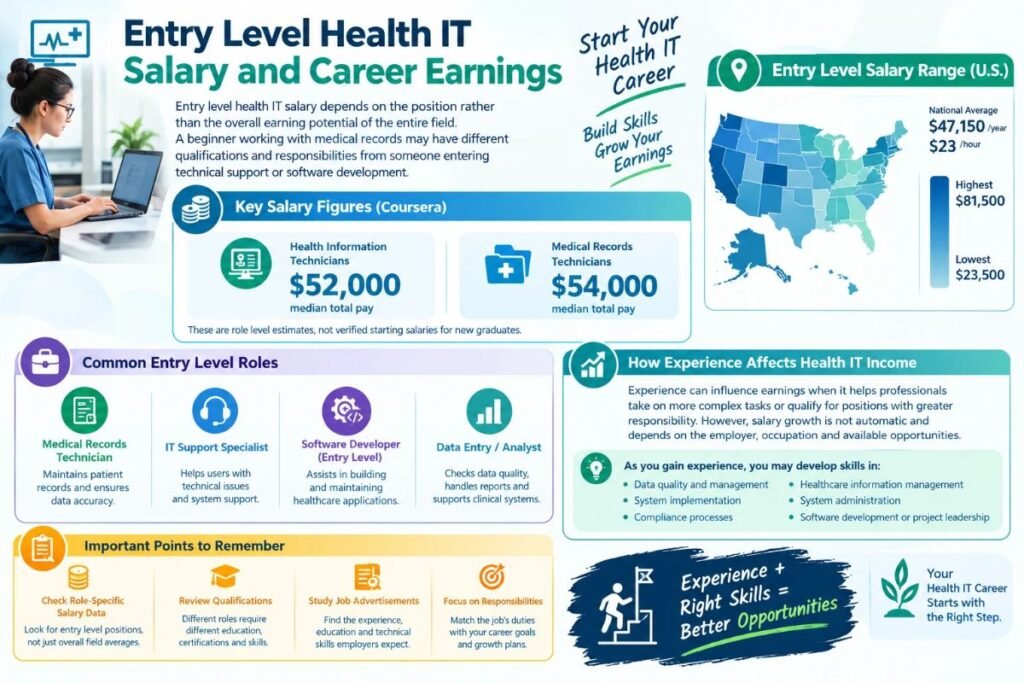
Entry level health IT salary depends on the position rather than the overall earning potential of the entire field. A beginner working with medical records may have different qualifications and responsibilities from someone entering technical support or software development.
Coursera’s salary table reports $52,000 in median total pay for health information technicians and $54,000 for medical records technicians. These figures are role level estimates, not verified starting salaries for new graduates.
A person beginning a career should therefore look for salary information specifically related to entry level positions. Job advertisements can help identify the experience, education and technical skills employers expect from applicants.
Early career responsibilities may include maintaining records, supporting users, checking data quality or assisting with healthcare information systems. More specialised responsibilities may require additional training or relevant work experience.
How Experience Affects Health IT Income
Experience can influence earnings when it helps professionals take on more complex tasks or qualify for positions with greater responsibility. However, salary growth is not automatic and depends on the employer, occupation and available opportunities.
An experienced health information professional may develop expertise in data quality, system implementation, compliance processes or healthcare information management. Technical professionals may progress into system administration software development or project leadership when their skills match those roles.
When comparing opportunities, consider the responsibilities attached to each position rather than assuming that years of experience alone guarantee a particular salary.
Health Information Technology Salary by Education
Education can affect the jobs available to candidates, but a degree does not guarantee a specific salary. Employers set requirements according to the position, the systems involved and the level of responsibility.
The BLS states that health information technologists and medical registrars typically need at least an associate degree. Some positions require a bachelor’s or higher degree, while certification may be required or preferred by employers.
Coursera’s September 2026 guide also associates different healthcare IT roles with different typical education levels. These descriptions are guidance about common pathways rather than proof that a particular degree will produce a stated income.
Associate Degree
An associate degree may provide a pathway into selected health information technology positions. Relevant programmes may cover healthcare information management, medical terminology, data requirements and related technical subjects.
Coursera lists health information technician and medical records technician roles among positions associated with associate level education or other entry pathways. Actual eligibility depends on the employer’s requirements and the candidate’s qualifications.
Candidates should compare programme content with the skills requested in current job listings before choosing a course.
Bachelor’s Degree
A bachelor’s degree may qualify candidates for a wider range of technical or management positions, depending on their field of study and experience. Relevant disciplines may include information technology, computer science and health information management.
Coursera associates bachelor’s level education with roles such as healthcare IT specialist software developer, system administrator and project manager. Its salary estimates do not establish that earning a bachelor’s degree alone causes higher pay.
The value of a degree depends on how well it matches the intended occupation and the requirements employers use when hiring.
Master’s Degree and Specialised Education
Some advanced healthcare information and management positions may require or prefer postgraduate education. The BLS notes that some health information technologist and medical registrar positions require a bachelor’s or master’s degree.
Further study may be relevant for professionals pursuing specialised health informatics, research, leadership or advanced analytical responsibilities. The appropriate qualification depends on the career direction rather than a universal salary target.
Before enrolling, compare course requirements, recognition, practical content and the qualifications listed in relevant job advertisements.
Does a Health IT Certification Increase Salary?
A certification may help demonstrate knowledge in a specific area, but it does not guarantee a pay increase. Its value depends on the credential, the employer’s requirements, the candidate’s existing qualifications and the position being pursued.
The BLS states that employers may prefer certified health information technologists and medical registrars or may expect employees to earn certification after being hired. Certification requirements vary across positions.
Before paying for a credential, review job advertisements to see whether employers require it, prefer it or do not mention it. Also consider the time and cost involved, eligibility requirements and how directly the certification relates to your intended role.
A relevant credential combined with practical experience may support career development, but salary decisions remain dependent on the employer and the position.
Health Information Technology Salary by State and Location
Health information technology salary can vary by state, metropolitan area and employer. Differences in local labour markets, living costs, employer types and the availability of specialised roles can influence the compensation offered.
ZipRecruiter provides location comparisons for its Healthcare Information Technology category. However, its national estimate should not be treated as a state specific salary figure and its figures may differ from official occupational wage statistics.
For a more consistent comparison, use the BLS Occupational Employment and Wage Statistics resources to review wage estimates by state and area for the relevant occupation. Make sure the selected occupational category matches the job you want to evaluate.
How to Compare State and City Salaries
Start by identifying the exact job title and responsibilities. A health information technician software developer and healthcare IT project manager should not be compared as though they belong to the same occupational category.
Next, check the reporting period and salary measure used by the source. Official wage data, job posting estimates and total compensation estimates can produce different results even when they refer to similar work.
Finally, consider local living costs, commuting, remote work arrangements and benefits. A higher advertised salary does not necessarily mean that a job will provide greater financial value after expenses.
Health IT Salary by Industry
Health IT salaries vary by employer because hospitals, technology companies and consulting firms have different staffing needs and job responsibilities.
According to BLS data for May 2025, the median annual wages for health information technologists and medical registrars across selected industries were:
- Management of companies and enterprises: $81,010 per year
- Administrative and support services: $75,560 per year
- Professional, scientific and technical services: $68,890 per year
- Hospitals (state, local and private): $67,480 per year
- Offices of physicians: $54,670 per year
These figures apply specifically to health information technologists and medical registrars, not all employees in these industries. Actual salaries vary by job title, experience, location and employer so a higher industry median does not guarantee higher pay for every position.
Career Outlook for Health Information Technology
The BLS projects employment of health information technologists and medical registrars to grow by 16 percent from 2025 to 2035. It also projects approximately 3,000 openings per year on average over that period.
The BLS connects this outlook with the growing volume of electronic health information and the need to analyse data, maintain clinical registries and support informed decisions. These figures apply to the defined occupational group, not every healthcare IT job title.
Career opportunities may also exist in related areas such as software development, technical support, system administration and project management. Their outlook and salary prospects should be assessed using the occupational data relevant to each role.
A career outlook indicates projected employment trends; it does not guarantee that every applicant will find a job or receive a particular salary.
Can Health Information Technology Professionals Earn Six Figures?
Coursera’s September 2026 guide reports salary estimates above $100,000 for some health IT roles, including software development, consulting and project management. These estimates vary by role and do not guarantee earnings across the field.
The BLS also reports that the highest paid 10 percent of health information technologists and medical registrars earned more than $117,420 annually in May 2025. This figure refers to the BLS occupational group and is different from the salary estimates for broader technology related roles.
Six figure earnings are therefore possible in some positions, but they should not be treated as a normal starting salary. The relevant occupation, experience, qualifications, location and employer all matter.
How to Compare Health IT Job Offers?

A useful salary comparison should look beyond the headline annual figure. Two offers with similar base pay may differ in benefits, working arrangements, responsibilities and opportunities for professional development.
First, confirm whether the quoted amount is base salary or total compensation. Ask how bonuses are calculated, whether they are guaranteed and whether any additional payments depend on performance or business results.
Second, compare benefits such as health insurance, retirement contributions, paid leave and professional development support. Their value depends on the terms of the offer and your individual circumstances.
Third, check the location, work schedule and remote work policy. A salary that looks attractive may provide less financial value if commuting or living expenses are substantially higher.
Finally, compare the role’s duties with your career goals. A position offering relevant experience, training or a clear path to more specialised work may be worth considering alongside immediate pay.
Conclusion
Health IT salaries vary across information management, technical support software development, consulting and project management. Compare salaries by specific role, reporting period and compensation type for a more accurate estimate.
Education, experience, specialised skills, location and employer type can all influence earning opportunities. However, degrees and certifications do not guarantee a particular salary and reported estimates should be treated as guidance rather than promises.
Before choosing a career path or accepting a job offer, compare reliable salary data, review the role’s responsibilities and assess the complete compensation package. This approach provides a clearer basis for evaluating health information technology income and planning your career.
FAQs
How much does health information technology pay per year?
Pay depends on the job title and salary source. The BLS reported a $68,020 median annual wage for health information technologists and medical registrars in May 2025, while other sources report different figures for broader healthcare IT categories.
What is the starting salary for health IT jobs?
There is no single starting salary for the entire field. Entry level earnings depend on the position, location, employer, education and experience requirements so candidates should compare salary information for specific entry level roles.
Which health information technology jobs pay the most?
Coursera’s September 2026 salary guide lists healthcare software developer, healthcare technology consultant and health IT project manager among its higher paid roles.
Does a health information technology degree increase income?
A degree can help candidates qualify for certain positions, but it does not guarantee a salary increase. Its value depends on the occupation, employer requirements, relevant skills and experience.
What factors affect health information technology income?
Important factors include job title, experience, education, certification, location, employer type and job responsibilities. Salary comparisons should also account for the difference between base pay, median wages, average salary and total compensation.