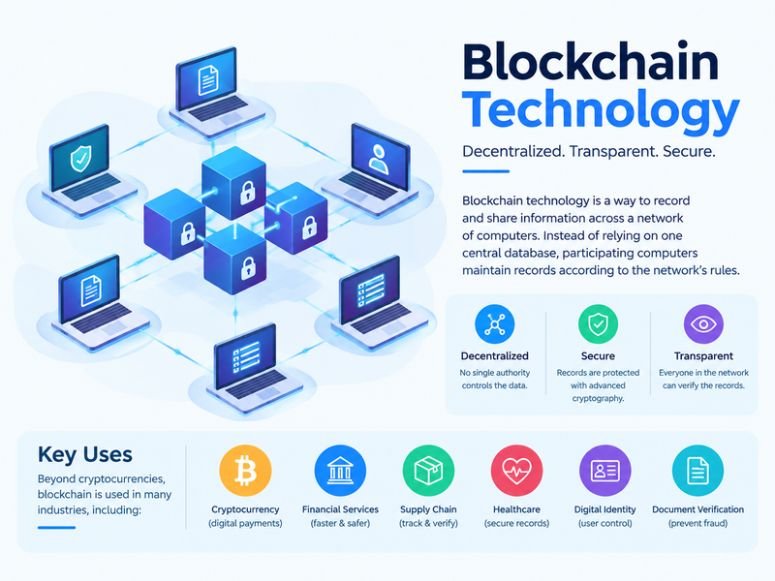
Blockchain technology is a way to record and share information across a network of computers. Instead of relying entirely on one central database, participating computers maintain records according to the network’s rules.
The technology is best known for supporting cryptocurrencies, but its applications extend to financial services, supply chain management, healthcare, digital identity and document verification. Its usefulness depends on how information needs to be shared, verified and protected.
Understanding blockchain technology means looking beyond its benefits. Businesses and individuals should also understand how transactions are verified, what makes records difficult to change and when a traditional database may be the better option.
Explore more technology-related topics and digital resources on Pepper0
What Is Blockchain Technology in Simple Terms?
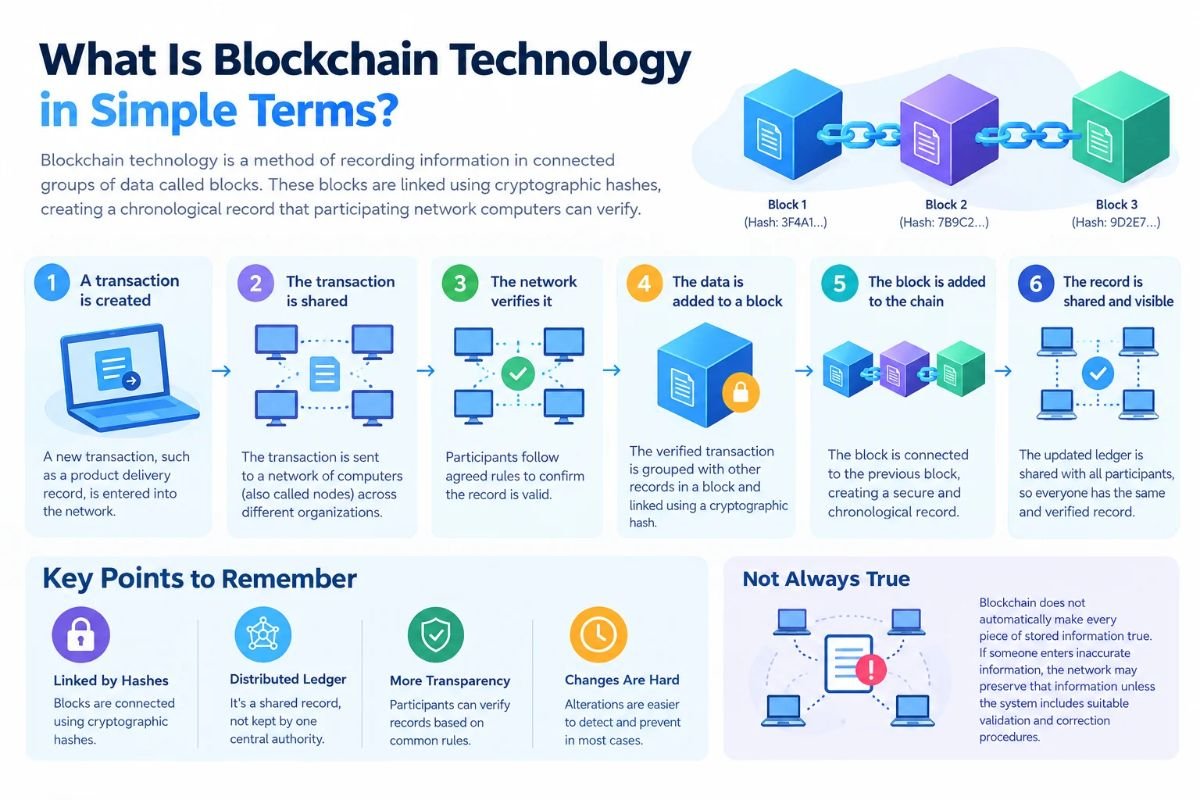
Blockchain technology is a method of recording information in connected groups of data called blocks. These blocks are linked using cryptographic hashes, creating a chronological record that participating network computers can verify.
A blockchain is a type of distributed ledger technology (DLT). A distributed ledger is a record of information shared across multiple participants rather than maintained exclusively by one central authority.
Imagine several organizations that need to maintain a shared record of product deliveries. Instead of each organization keeping separate records and regularly comparing them, they could use a shared ledger to record agreed transactions.
Depending on the network design, participants can verify records according to common rules. This can improve coordination and make unauthorized changes easier to detect.
However, blockchain does not automatically make every piece of stored information true. If someone enters inaccurate information, the network may preserve that information unless the system includes suitable validation and correction procedures.
What Are the Main Components of Blockchain Technology?
Blockchain technology combines several components to record, distribute and verify information. Understanding these components makes it easier to see how the technology works in practice.
Blockchain Blocks and Nodes
A block is a group of records or transactions processed together. Depending on the blockchain, a block may contain transaction data, a timestamp, a reference to the previous block and other information required by the protocol.
A node is a computer or system that participates in a blockchain network. Depending on its role, a node may store records, share information, verify transactions or help maintain the network.
When a new block is accepted, participating nodes follow the network’s rules to update or verify their records. The precise process differs between blockchain systems.
Blockchain Cryptography
Cryptography helps protect information and verify its integrity. One important technique is hashing, which converts input data into a fixed length output.
A small change to the input generally produces a different hash. Blockchain systems use hashes to link blocks and help detect changes to previously recorded information.
Some networks also use digital signatures. These allow participants to verify that a transaction was authorized by the holder of the relevant private key.
Cryptography strengthens blockchain security, but it does not eliminate every risk. Stolen private keys software vulnerabilities and poorly designed applications can still create serious problems.
Blockchain Consensus Mechanism
A consensus mechanism is the process a blockchain network uses to agree on which transactions or blocks should be accepted.
Different networks use different approaches. Proof of Work requires participants to perform computational work, while Proof of Stake uses participants who commit eligible assets under the network’s rules.
Other networks may use different voting or validation arrangements, particularly in permissioned business environments.
The choice of consensus mechanism affects network security, performance, resource requirements and governance. No single approach is ideal for every blockchain application.
How Does Blockchain Technology Work Step by Step?
The exact process varies between networks, but a typical blockchain transaction follows several stages.
A transaction is initiated. A participant submits a transaction, such as recording a payment or updating a product’s ownership information.
The network checks the transaction. Participating nodes or designated validators examine the transaction according to the network’s rules. Checks may include authorization, available balances and transaction format.
Valid transactions are grouped. Depending on the blockchain, accepted transactions are collected into a proposed block or processed through another block production procedure.
The network reaches agreement. The applicable consensus mechanism determines whether the proposed block can be accepted. The requirements differ between public and permissioned networks.
The block joins the chain. An accepted block is linked to previous records, commonly through cryptographic hashes. Participating nodes update their records according to the protocol.
The transaction gains confirmation. Additional blocks or network specific confirmation procedures may strengthen confidence that the transaction will remain part of the accepted record.
For example, a supplier could record that a shipment has left a warehouse. Authorized participants could verify the record and use it to coordinate later stages of delivery.
The blockchain can preserve the submitted record, but it cannot independently prove that the shipment physically left the warehouse unless reliable information from the real world is provided.
What Are the Four Types of Blockchain?
Blockchain networks are commonly categorized as public, private, permissioned and consortium blockchains. These categories can overlap because they describe different aspects of network access and governance.
Public Blockchain: Allows participation according to publicly defined network rules. It offers openness and transparency but may provide limited transaction privacy.
Private Blockchain: Is controlled by a single organization that manages participation and governance. It offers greater control but requires trust in the governing organization.
Permissioned Blockchain: Restricts specific activities to authorized participants. It supports controlled access and clearly defined responsibilities.
Consortium Blockchain: Is governed by a selected group of organizations that share network responsibilities. It is useful when multiple organizations need to maintain shared records and coordinate activities.
Public and Private Blockchain
A public blockchain allows people to participate according to its published rules. Depending on the network, users may be able to submit transactions, inspect records and participate in validation.
A private blockchain restricts participation under the control of an organization. It may be suitable when a business needs a shared record while limiting access to approved participants.
The choice depends on transparency, privacy, governance and trust requirements. A public network may be unsuitable for confidential business information, while a private network may offer fewer benefits when participants do not trust the organization controlling it.
Permissioned Blockchain
Permissioned blockchain networks restrict particular activities to authorized participants. Permissioning can control who may submit transactions, validate records or access specific information.
A permissioned network can be private, but permissioned and private do not always mean exactly the same thing. Public networks can also impose restrictions on particular activities.
Consortium Blockchain
A consortium blockchain is governed by several selected organizations rather than a single organization. Participants may agree on rules for maintaining records, validating transactions and managing access.
For example, several companies in a supply chain could jointly manage a ledger for recording shipments. This arrangement may improve coordination, but the participants still need clear governance, responsibility and dispute resolution procedures.
What Are the Benefits of Blockchain Technology?
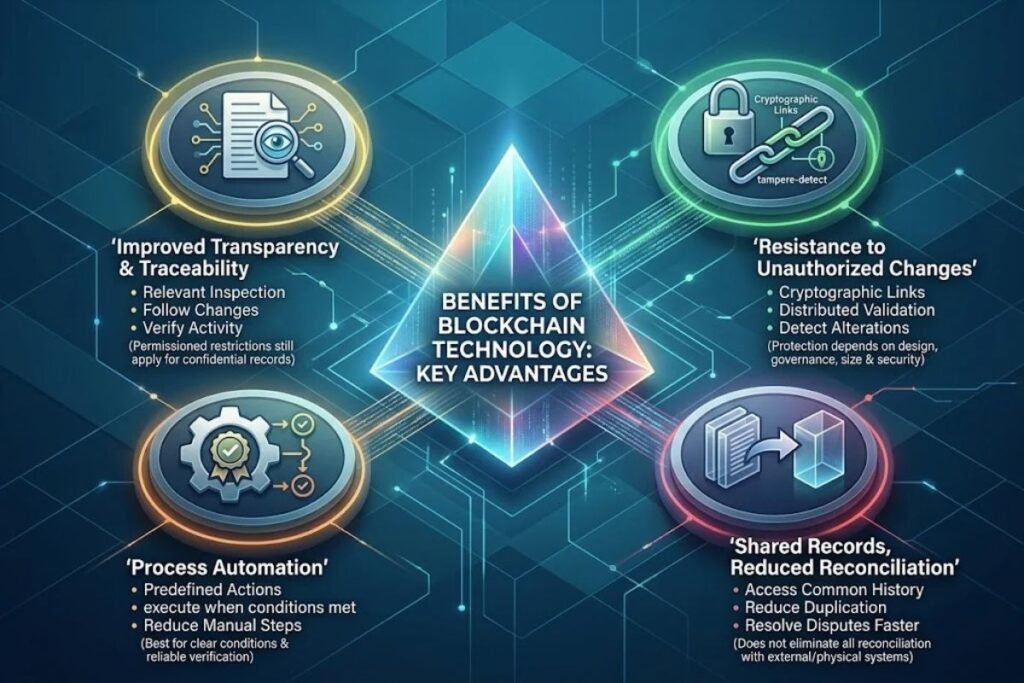
Blockchain technology can offer advantages when multiple participants need to maintain a shared record without relying entirely on separate databases or manual reconciliation.
Improved Transparency and Traceability
Depending on network permissions, participants can inspect relevant transactions and follow changes to recorded information. This can create a useful audit trail for activities such as product movement or document verification.
Transparency does not necessarily mean that every participant can view all information. Permissioned systems can restrict access to confidential records.
Greater Resistance to Unauthorized Changes
Cryptographic links and distributed validation make unauthorized record changes easier to detect. Altering an earlier block may require overcoming the network’s validation rules and other technical protections.
This is why blockchain records are often described as tamper resistant. The level of protection depends on the network’s design, governance, size and security.
Shared Records and Reduced Reconciliation
Organizations that maintain separate records may spend time identifying inconsistencies and resolving disputes. A shared ledger can reduce some duplication by giving participants access to a common transaction history.
However, blockchain does not eliminate every reconciliation task. Businesses may still need to compare blockchain records with external systems, physical events and legal documents.
Process Automation
Blockchain smart contracts can execute predefined actions when their programmed conditions are satisfied. This can reduce manual steps in suitable workflows.
Automation is most effective when the conditions are clear and the required information can be verified reliably. Complex exceptions may still require human involvement.
What Are the Disadvantages and Limitations of Blockchain?
Blockchain technology has limitations that businesses should consider before investing in it. A shared ledger may solve a coordination problem, but it can also introduce technical and operational complexity.
Scalability and speed: Some networks process transactions more slowly than centralized databases or conventional payment systems. Performance depends on the consensus mechanism, network design, transaction demand and available scaling methods.
Implementation costs: Expenses may include software development, infrastructure, integration, security testing, governance and staff training. A blockchain project can be costly even when the underlying software is open source.
Privacy concerns: Public blockchain records may reveal transaction patterns or other information. Removing names does not always prevent people from connecting an address with an identity.
Difficult corrections: Blockchain records are designed to resist changes after confirmation. Correcting an error may require a new transaction or an application level process rather than deleting the original record.
Governance challenges: Participants must agree on access software updates, responsibilities and dispute resolution. Disagreement can delay changes or weaken cooperation.
Security weaknesses: Blockchain protocols can be robust while the applications built around them remain vulnerable. Smart contract errors, stolen credentials, compromised devices and insecure integrations can expose users to losses.
These limitations mean blockchain should be evaluated against the actual problem rather than selected simply because it is a modern technology.
How Is Blockchain Different From a Traditional Database?
Blockchain distributes record validation according to network rules, while traditional databases are usually managed by a central organization. The best option depends on data control, trust, privacy and performance requirements.
- Control: Blockchain may distribute control among participants, while traditional databases usually have a central administrator.
- Record Changes: Blockchain makes confirmed records difficult to alter, whereas authorized users can typically update or delete database records.
- Validation: Blockchain uses network rules and sometimes consensus mechanisms, while databases rely on permissions and application rules.
- Performance: Traditional databases often handle high volume operations efficiently, while blockchain performance depends on its design and validation process.
- Privacy: Blockchain privacy varies by network and access controls, while traditional databases can restrict access through detailed permissions.
- Governance: Blockchain may require coordination among multiple participants, while traditional databases are generally governed by their owners.
- Best Use: Blockchain suits shared records requiring verification across independent parties, while traditional databases suit applications needing centralized control and efficient data management.
Businesses should consider blockchain when multiple independent parties need a common, verifiable transaction history. If one organization controls the process, a traditional database may be simpler, faster and less expensive.
What Is the Difference Between Blockchain and Cryptocurrency?
Blockchain and cryptocurrency are related, but they are not the same thing.Blockchain is the underlying technology used to record and verify information across a network. Cryptocurrency is a digital asset designed to operate within a digital monetary or token based system.
Bitcoin is a cryptocurrency that uses blockchain to record transactions. Other blockchain networks support different digital assets, applications or business processes.
Blockchain technology does not inherently require cryptocurrency. Some enterprise networks use permissioned systems to share records or automate workflows without requiring a publicly traded digital currency.
The distinction matters because a business can evaluate blockchain for recordkeeping without necessarily deciding to use or invest in cryptocurrency.
How Are Blockchain Smart Contracts Used?
A smart contract is software deployed on a blockchain that executes programmed instructions when specified conditions are met. It can automate parts of an agreement or business process without requiring every step to be handled manually.
For example, a supply agreement could use a smart contract to release a payment after an authorized system records that the required delivery conditions have been satisfied.
The contract can perform its programmed action, but it cannot independently confirm a physical delivery unless it receives trustworthy information from an external source.
Smart contracts also have limitations. Coding mistakes, unclear conditions, unreliable external data and unexpected situations can cause problems. Firms should test the code, establish appropriate permissions and plan how errors or disputes will be handled.
How Is Blockchain Technology Used in Real Life?
Blockchain technology use cases vary by industry. It is most relevant when several parties need to share records, verify transactions or maintain a consistent history of events.
Blockchain in Financial Services
Financial institutions may explore blockchain for transaction records, settlement processes, digital assets and shared financial workflows.
A shared ledger could help participating institutions coordinate transaction information and reduce some reconciliation work. However, regulatory requirements, privacy, interoperability and operational risks must be considered.
Blockchain does not automatically make financial transactions faster or cheaper. Results depend on the network, participants and surrounding systems.
Blockchain in Supply Chain Management
Supply chain management involves tracking products as they move between suppliers, manufacturers, warehouses and retailers.
Blockchain can provide a shared record of shipment events, product identifiers and relevant documentation. Participants may use this history to investigate delays or trace the reported origin of goods.
The limitation is that blockchain records what participants or connected systems submit. Physical inspections, reliable data collection and appropriate verification remain necessary to confirm real world claims.
Blockchain in Healthcare
Healthcare organizations may explore blockchain for record verification, consent management and coordination between authorized participants.
For example, a system could maintain a verifiable record of when a medical document was created or updated. The actual medical information could remain in a protected system, with blockchain used for selected verification details.
Healthcare applications must consider patient privacy, access permissions, data protection and applicable regulations. Storing sensitive medical information directly on an immutable public ledger may create serious privacy challenges.
Blockchain in Government and Document Verification
Government applications may include digital certificates, document verification, property records, logistics and selected administrative workflows.
A blockchain can help participating organizations check whether a record matches an accepted ledger entry. However, legal validity still depends on the relevant laws, issuing authorities and governance arrangements.
Blockchain cannot replace the need to confirm that the original information was accurate and submitted by an authorized source.
What Are the Challenges of Implementing Blockchain?
Blockchain implementation requires more than selecting a platform. Organizations must determine whether a distributed ledger solves a problem that existing systems cannot address adequately.
Start by identifying the business objective. Specify which records need to be shared, which organizations will participate and what problems exist with the current process.
Next, assess whether participants need distributed control or whether a conventional database would be sufficient. If one organization can manage the records and access permissions effectively, blockchain may add unnecessary complexity.
If a blockchain appears suitable, define governance and access rules before development. Participants should agree on who can submit transactions, validate records, access information and approve network changes.
The implementation team should then evaluate integration, privacy, security, performance and data quality requirements. A small pilot can help identify problems before the organization commits to a larger deployment.
How Much Does Blockchain Implementation Cost?
Blockchain implementation costs vary by project. Relevant factors include the number of participants, network type software development, infrastructure, integration, security reviews, ongoing maintenance and governance arrangements.
There is no reliable universal price for a blockchain solution without knowing the project’s requirements. Public blockchain transactions may also involve network fees, while private or enterprise systems can create infrastructure and administration expenses.
Organizations should compare the full lifecycle cost with the cost of alternative solutions. They should also define measurable outcomes, such as reduced reconciliation effort, better traceability or fewer manual verification steps.
What Is the Future of Blockchain Technology?
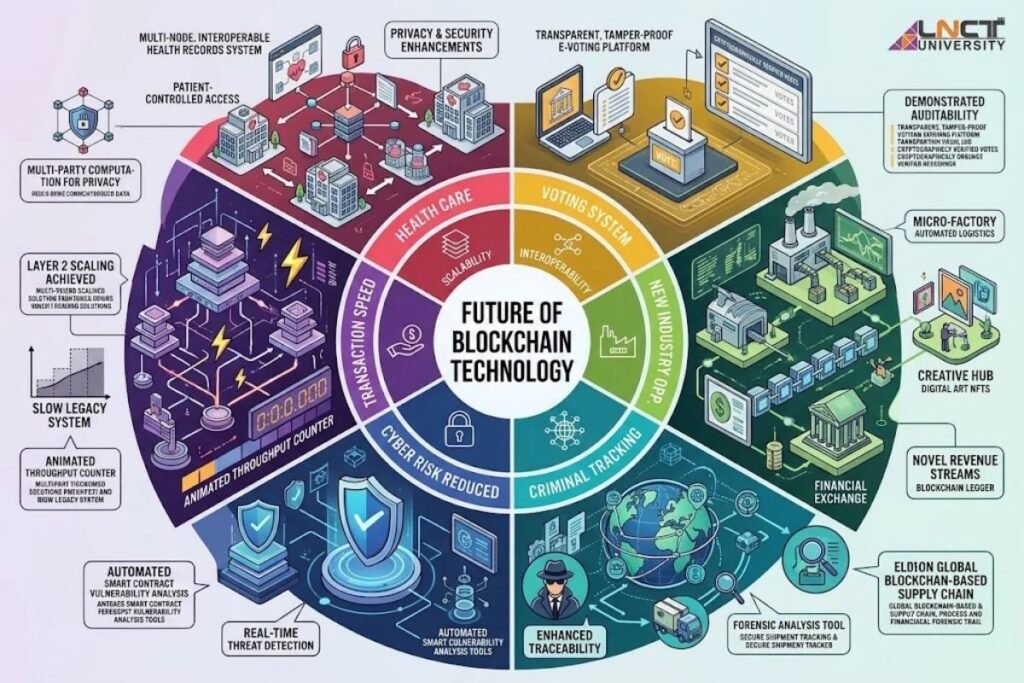
The future of blockchain technology will depend on whether it can provide practical value while addressing scalability, privacy, security, interoperability and governance challenges.
Potential areas of development include digital asset infrastructure, shared business records, automated agreements and improved connections between blockchain networks and existing systems.
These are areas of ongoing development, not guarantees of widespread adoption. Organizations should evaluate actual capabilities, legal requirements, operating costs and demonstrated results before committing resources.
The strongest use cases are likely to be those in which a shared, verifiable record solves a clearly defined problem better than available alternatives.
Conclusion
Blockchain technology provides a way to maintain shared records across a network using blocks, cryptography and validation rules. It can support transparency, traceability and coordinated workflows in financial services, supply chains, healthcare and other industries.
However, blockchain also introduces challenges involving cost, scalability, privacy, governance and security. Its records are designed to resist unauthorized changes, but the technology cannot guarantee that submitted information is accurate or that every application is secure.
Businesses should choose blockchain when its shared record model offers a clear advantage over a traditional database. A careful assessment of requirements, risks, implementation costs and measurable benefits can help determine whether the technology is the right solution.
FAQs
Is blockchain technology secure?
Blockchain can make unauthorized changes to confirmed records difficult to perform without detection. However, security depends on the network software, access controls, private key protection and application design.
Can blockchain data be changed or deleted?
Confirmed records are generally designed to be tamper resistant, but the exact rules vary by network. Errors may be corrected through additional transactions, while applications may use separate procedures for handling or restricting access to information.
Does blockchain technology require cryptocurrency?
No. Blockchain networks can support shared records, document verification and business workflows without requiring a publicly traded cryptocurrency. Requirements depend on the specific network and application.
Which industries benefit most from blockchain technology?
Potential applications exist in financial services, supply chains, healthcare, government and document verification. The technology is most relevant when multiple parties need shared records and independent verification.
When should a business choose blockchain instead of a traditional database?
Blockchain may be suitable when several independent parties need a shared, verifiable transaction history and no single party should control the complete recordkeeping process.