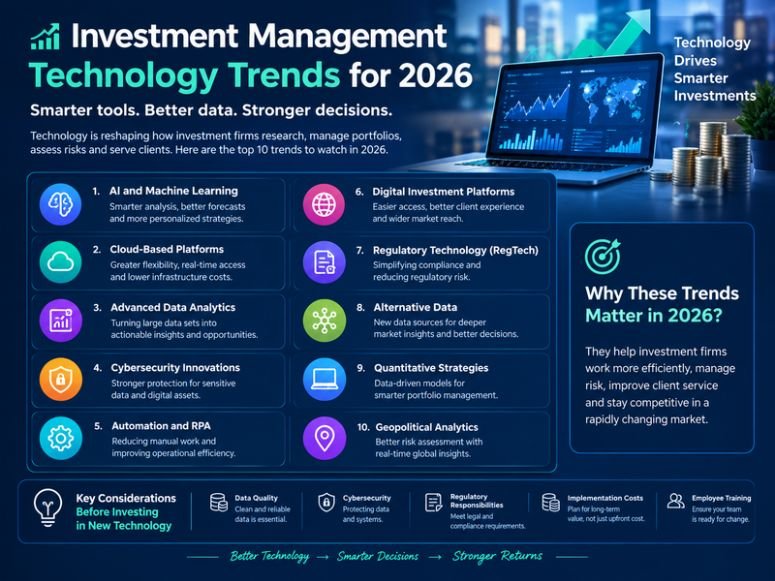
Investment management technology trends are changing how firms research investments, manage portfolios, assess risks and serve clients. Artificial intelligence, automation, data analytics and digital platforms help investment teams process information and improve daily operations.
However, adopting new technology requires more than purchasing software. Firms must consider data quality, cybersecurity, regulatory responsibilities, implementation costs and employee training before making investment decisions about technology.
Understanding investment management technology trends in 2026 helps firms identify practical opportunities while evaluating emerging technologies carefully. The right approach depends on business objectives, existing systems, available resources and client requirements.
What Are the Top Investment Management Technology Trends in 2026?
Investment management technology includes the software, infrastructure and digital tools firms use for research, portfolio management, trading, reporting, compliance and client communication.
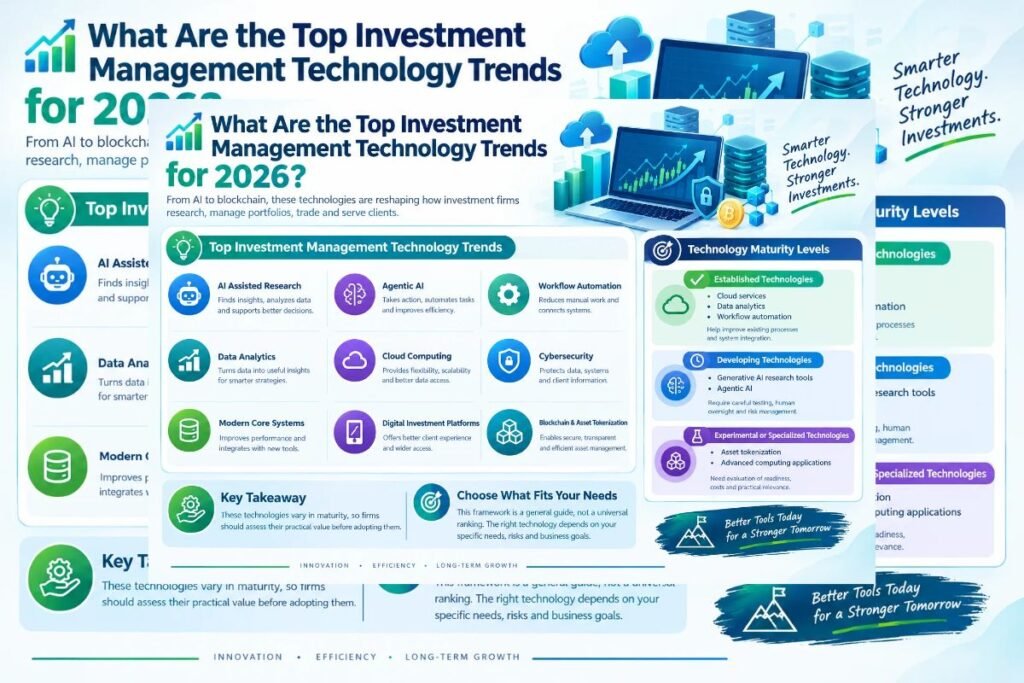
Key trends in 2026 include AI assisted research, agentic AI, workflow automation, data analytics, cloud computing, cybersecurity, modern core systems, digital investment platforms and blockchain based asset tokenization.
These technologies vary in maturity so firms should assess their practical value before adopting them.
- Established Technologies: Cloud services, data analytics and workflow automation help improve existing processes and system integration.
- Developing Technologies: Generative AI research tools and agentic AI require careful testing, human oversight and risk management.
- Experimental or Specialized Technologies: Asset tokenization and advanced computing applications require evaluation of readiness, costs and practical relevance.
This framework is a general guide rather than a universal industry ranking. Firms should choose technologies based on their specific needs, risks and business goals.
How Is AI Changing Investment Management?
AI in investment management helps professionals process information, identify patterns, summarize documents and support selected analytical tasks. It can reduce time spent gathering information and organizing research materials.
For example, an AI tool may summarize company reports or extract relevant information from approved documents. Analysts can review these outputs and decide which findings deserve further investigation.
AI powered investment research can improve efficiency, but it does not guarantee accurate analysis or better investment returns. Results depend on data quality, model capabilities and appropriate human review.
Artificial Intelligence in Asset Management
Artificial intelligence in asset management can support investment research, portfolio monitoring, reporting and client service. Firms may use AI tools to organize financial information, compare documents or prepare initial drafts of internal reports.
These applications can make information easier to review, but AI systems may misunderstand context or generate incorrect conclusions. Professionals should verify important outputs against reliable source documents before using them.
How Do Investment Firms Use Agentic AI?
Agentic AI refers to systems designed to complete multiple connected tasks toward a defined objective. Depending on their configuration, these systems may retrieve approved information organize results and prepare work for human review.
For example, an investment firm could test an agentic AI workflow that gathers research documents, summarizes relevant information and prepares a report for an analyst.
Firms should define the system’s permissions, data access, approval requirements and limits. High impact activities, such as executing trades or changing portfolios, require appropriate safeguards and oversight.
What Role Does Data Analytics Play in Investment Decisions?
Investment data analytics helps firms interpret financial information for research, portfolio construction, performance measurement and risk management.
Relevant information may include market prices, financial statements, portfolio holdings, transaction records and economic indicators. Combining these sources can help analysts evaluate investments from different perspectives.
However, more data does not automatically produce better decisions. Information may be incomplete, outdated, duplicated or unsuitable for a particular analytical model.
Investment Management Data Infrastructure
Investment management data infrastructure includes the systems used to collect organize, store, protect and distribute information.
Reliable infrastructure helps teams work with consistent data across research, portfolio management, trading and reporting. It also supports AI applications that depend on accessible, relevant and properly governed information.
Firms should establish data ownership, validation rules, access permissions and procedures for correcting errors. They should also understand where important information originates and how it moves between systems.
AI Powered Investment Research
AI powered investment research can assist with document summarization, financial report comparison and information retrieval.
For example, an analyst could use an approved tool to extract relevant figures from company reports and prepare a preliminary comparison. The analyst must still verify those figures, review the original documents and apply independent judgment.
What Are the Benefits of Investment Management Automation?
Investment management automation uses software to complete repetitive tasks with less manual intervention. It can reduce administrative effort, improve consistency and help employees focus on work requiring professional judgment.
Examples include reconciling records, preparing routine reports, routing documents for approval and sending alerts when predefined conditions occur.
Automation works best when processes are clearly defined and information is reliable. Automating a poorly designed process may simply reproduce existing problems more quickly.
How Technology Improves Portfolio Management
Investment portfolio management software helps professionals monitor holdings, review allocations, analyze performance and assess portfolio risks. Depending on the platform, it may also support rebalancing, accounting, trading workflows and client reporting.
For example, a portfolio manager could use software to identify differences between current allocations and approved targets. The system might prepare a proposed adjustment for review.
Actual capabilities vary between platforms. Firms should confirm that a solution supports their asset classes, investment strategies, reporting requirements and internal controls.
Traditional vs. Modern Investment Management Technology
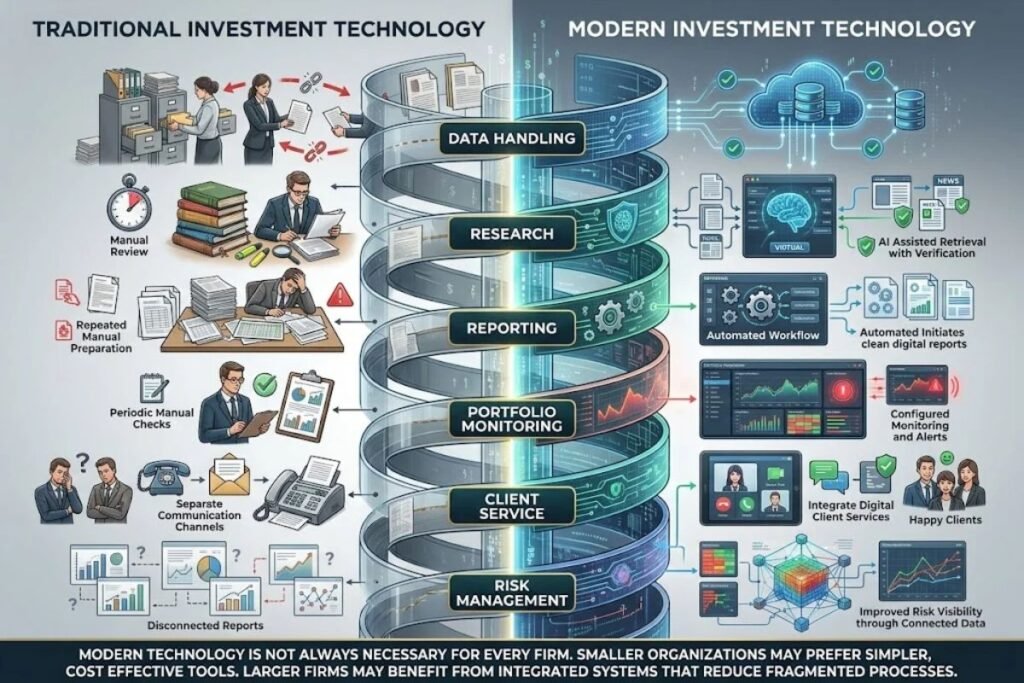
- Data Handling: Traditional methods rely on separate files and manual transfers, while modern systems connect data through controlled sharing.
- Research: Traditional research involves manual document reviews, whereas modern tools support AI assisted information retrieval with verification.
- Reporting: Traditional reporting requires repeated manual preparation, while modern workflows automate many reporting tasks.
- Portfolio Monitoring: Traditional approaches use periodic manual checks, while modern systems provide configured monitoring and alerts.
- Client Service: Traditional methods use separate communication channels, whereas modern platforms integrate digital client services.
- Risk Management: Traditional processes often rely on disconnected reports, while modern analytics improve risk visibility through connected data.
Modern technology is not always necessary for every firm. Smaller organizations may prefer simpler, cost effective tools, while larger firms may benefit from integrated systems that reduce fragmented processes.
How Is Cloud Computing Used in Asset Management?
Cloud computing in asset management allows firms to use computing resources software and data services hosted on remote infrastructure.
Depending on the service, cloud technology can support data storage, analytics, collaboration, reporting and application hosting. It can also help firms adjust computing resources to meet changing requirements.
However, cloud adoption requires careful assessment of data residency, access controls, service availability, recovery procedures and provider responsibilities. Moving applications to the cloud does not remove a firm’s responsibility to protect its information.
Why Investment Management Core Systems Matter
Investment management core systems support essential processes such as portfolio management, trading, accounting, compliance and reporting.
When systems operate separately, employees may need to reconcile information manually or maintain duplicate records. Reliable integration can improve consistency and reduce unnecessary data transfers.
Replacing core systems can be expensive and disruptive. Firms should evaluate migration requirements, compatibility, training, operational continuity and total costs before replacing existing platforms.
How Can Investment Firms Improve Cybersecurity?
Investment management cybersecurity protects client information, financial records, business systems and confidential research from unauthorized access, disruption and data loss.
Useful security measures include multifactor authentication, least privilege access, encryption where appropriate, secure backups, vulnerability management and suspicious activity monitoring.
Firms should also establish incident response procedures and review the security practices of technology providers. Employee training is important because mistakes involving credentials, confidential documents or suspicious messages can expose sensitive information.
AI Governance in Financial Services
AI governance in financial services defines how firms approve, use, monitor and control AI systems. It should address data access, model limitations, human oversight, accountability and error handling.
Organizations should maintain an inventory of AI tools and document their approved purposes, permitted data, review requirements and responsible teams.
AI systems should be tested for accuracy, reliability and inappropriate data exposure. Firms must also consider applicable regulatory and contractual obligations because AI adoption does not remove existing compliance responsibilities.
How Is Blockchain Changing Investment Management?
Blockchain is a distributed ledger technology that records transactions through a shared digital recordkeeping structure. Its usefulness depends on the asset, network design, governance arrangements and legal framework.
One potential application is asset tokenization, where rights associated with an asset are represented digitally through tokens. Depending on the arrangement, this may support the recording or transfer of ownership interests.
However, creating a token does not automatically establish legal ownership, guarantee liquidity or remove custody and compliance requirements.
Blockchain and Asset Tokenization
Firms considering asset tokenization should assess legal enforceability, custody arrangements, investor protections, interoperability and applicable regulations.
They should also compare blockchain with conventional databases. A traditional system may be more suitable when an established organization can manage records efficiently without the additional complexity of a distributed network.
How Can Investment Firms Implement New Technology Safely?
Investment management technology adoption should begin with a clearly defined business problem rather than pressure to follow a trend.
First, identify the problem. Document the existing process, the people involved and the issue that needs improvement. Examples include repeated data entry, slow reporting or fragmented client information.
Second, assess readiness. Check data accuracy, system compatibility, access permissions, security requirements and integration limitations before choosing a solution.
Third, compare costs and capabilities. Evaluate software licensing, implementation, customization, training, maintenance and support. Confirm contract terms and responsibilities before committing.
Fourth, run a controlled pilot. Test the technology with a limited use case, approved data, defined permissions and clear success criteria. Compare its results with the existing process.
Finally, evaluate before expanding. Review performance, errors, employee feedback, costs and risks. Expand only when the evidence supports the decision and appropriate controls are in place.
How Much Does Investment Management Technology Cost?
Investment management technology costs vary according to software capabilities, users, deployment models, integration complexity, data requirements and support needs. There is no single price that applies to every firm.
A subscription may represent only part of the total cost. Implementation, data migration, customization, employee training, maintenance and internal project time can also affect the budget.
Firms should request detailed pricing and confirm whether fees depend on users, assets managed, transaction volumes or additional features. They should also review renewal terms, support arrangements, service limitations and exit costs.
How Can Firms Measure Technology ROI?
Technology return on investment (ROI) compares the value generated by a project with its associated costs.
Firms can measure changes in reporting time, processing errors, reconciliation effort, system availability, employee adoption and client service response times. The chosen metrics should reflect the project’s original objectives.
Results should be compared with a baseline and evaluated alongside implementation and ongoing expenses. If expected improvements do not appear, firms should investigate whether the cause involves the technology, data quality, training or implementation.
What Are the Biggest Barriers to Adopting New Investment Technologies?
Investment management technology adoption can be limited by legacy systems, fragmented data, budget constraints, employee resistance, skills gaps and uncertainty about regulatory responsibilities.
These challenges often overlap. For example, an AI tool may perform poorly when its source data is incomplete, while an older application may complicate integration with a new platform.
Firms can address these problems by assigning clear ownership, involving employees early, documenting processes and introducing changes in manageable stages. Training should explain how to use new tools, recognize errors and escalate unusual results.
Technology projects also need ongoing monitoring after launch. Regular reviews help firms identify operational problems and determine whether the solution continues to meet business requirements.
What Is the Future of Investment Management Technology?
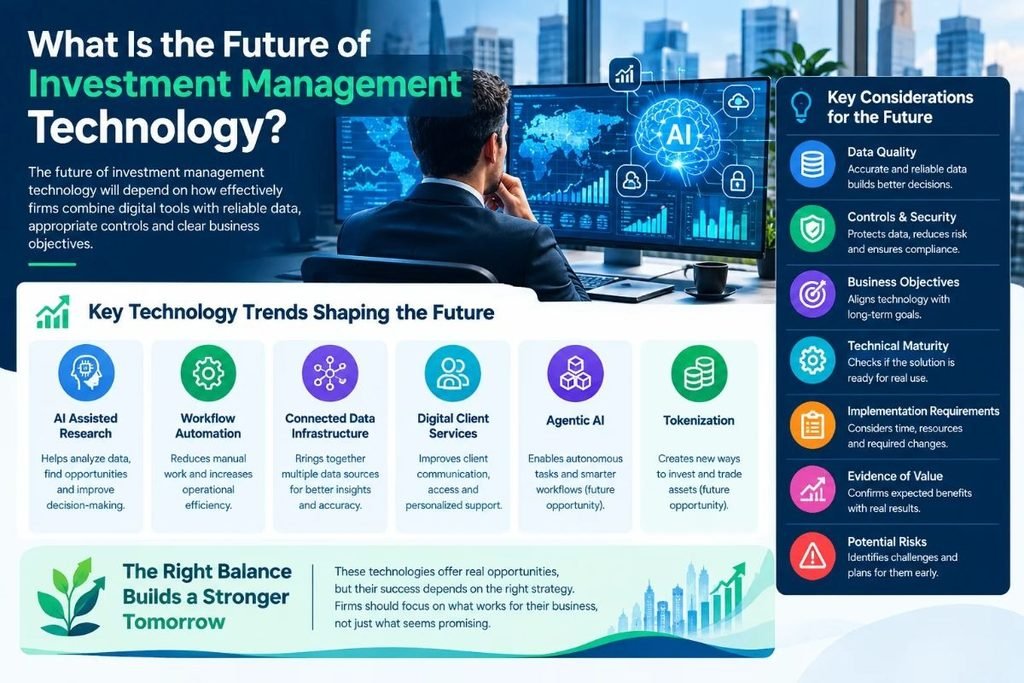
The future of investment management technology will depend on how effectively firms combine digital tools with reliable data, appropriate controls and clear business objectives.
AI assisted research, workflow automation, connected data infrastructure and digital client services offer practical areas for development. Agentic AI and tokenization may create further opportunities, but their suitability depends on specific use cases and operating conditions.
Firms should distinguish existing capabilities from predictions about future developments. Before making significant investments, they should evaluate technical maturity, implementation requirements, evidence of business value and potential risks.
Investment management technology trends in 2026 include AI, automation, data analytics, cloud computing, cybersecurity, digital platforms and selected blockchain applications. These technologies can support research, portfolio management, operational efficiency and client services.
Successful adoption requires reliable data, appropriate security controls, employee training, clear governance and realistic cost assessments. Firms should understand the limitations of each technology before relying on its outputs.
The most effective investment management technology strategy focuses on measurable business value and careful implementation. Firms should select technologies according to their needs rather than adopting every emerging trend.
FAQs
What are the top investment management technology trends in 2026?
Key trends include AI assisted research, agentic AI, automation, data analytics, cloud computing, cybersecurity, modern core systems, digital platforms and selected applications of blockchain.
How is AI changing investment management?
AI can help organize research, summarize documents, identify patterns and support selected workflows. Its outputs still require verification because systems can produce errors or miss important context.
What are the benefits of investment management automation?
Automation can reduce repetitive manual work, improve consistency and free employees to focus on complex tasks. Its effectiveness depends on reliable data, suitable workflows and proper exception handling.
What risks should investment firms consider before adopting AI?
Risks include inaccurate outputs, data exposure, bias, insufficient oversight, cybersecurity weaknesses and compliance issues. Firms should control access, define approved uses and monitor performance.
How can investment firms measure technology ROI?
Firms can compare project costs with measurable changes in productivity, processing time, errors, system availability, employee adoption and client service. Metrics should match the project’s objectives.