AI artificial intelligence refers to technology that enables computers and machines to perform tasks commonly associated with human intelligence. These tasks include learning from information, recognizing patterns, understanding language solving problems and making predictions.
You already interact with artificial intelligence technology in everyday situations. Smartphone face recognition, email spam filters, navigation apps, voice assistants and online shopping recommendations are common examples of intelligent computer systems working behind the scenes.
AI is also changing healthcare, education, transportation, business and entertainment. Understanding how it works, where it is used and what limitations it has can help people use AI powered applications more effectively and responsibly.
For more helpful technology guides, digital learning resources and practical tutorials, visit the Pepper0 homepage to explore our latest articles.
What Is AI Artificial Intelligence?

Artificial intelligence (AI) is a branch of computer science that enables systems to perform tasks requiring human intelligence. Some AI systems learn patterns from data to generate predictions, recommendations and useful results.
For example, a smartphone can use facial recognition to identify its registered owner. An email service can recognize suspicious messages while a streaming platform can recommend films based on viewing activity.
These systems do not necessarily understand information in the same way humans do. They process inputs using algorithms, statistical models and learned patterns to produce particular outputs.
The term AI covers several connected technologies, including machine learning, deep learning, natural language processing and computer vision. Together, these technologies support many modern digital services.
How Does AI Artificial Intelligence Work?
AI systems generally depend on three important elements: data, algorithms and computing power. Data provides examples, algorithms define how information is processed and computing resources allow models to perform calculations.
The exact process depends on the type of AI being developed. However, a typical machine learning system follows several stages.
Data Collection
The first stage involves collecting information relevant to the task. Data may include text, images, videos, audio recordings, numerical information or sensor readings.
For example, an AI system designed to recognize animals may be trained using a collection of labeled photographs. The examples need to represent the task accurately so the system can learn useful patterns.
Data Processing
Collected information is prepared before it is used for training. This may involve removing duplicate entries, correcting errors organizing information and converting data into a suitable format.
Good quality data matters because incomplete, inaccurate or unrepresentative information can affect the model’s results.
Pattern Recognition
AI algorithms examine the prepared information to identify patterns and relationships. An image recognition system, for example, may learn to identify shapes, colors, edges and other visual features.
These patterns help the system distinguish between different types of information. The model uses them to handle new examples that were not included in its original training data.
Model Training
During training, a machine learning model processes examples and adjusts its internal parameters to improve its performance on a particular task.
In supervised learning, the model receives examples with known answers. It compares its predictions with those answers and adjusts its parameters to reduce errors.
Other approaches use unlabeled information or feedback based on rewards. The training method depends on the problem and the available data.
Prediction and Decision Making
After training, the model can process new information and generate an output. This could be a prediction, classification, recommendation, generated response or another result.
For example, an email filtering system may estimate whether a new message resembles spam. A navigation application may analyze available information to suggest a route.
AI outputs are not automatically correct. Their reliability depends on the model, the information provided and the conditions in which the system operates.
Continuous Evaluation
AI models need evaluation to determine whether their outputs remain useful and reliable. Developers may test them with new data, examine errors, monitor performance and update models when necessary.
Some systems are retrained or adjusted as new information becomes available. Others operate with a fixed model until developers release an update.
Human review is important when incorrect results could affect people’s safety, finances, privacy or important decisions.
What Are the Main Types of AI Artificial Intelligence?
Artificial intelligence is commonly classified into three capability levels:
- Narrow AI (ANI): Performs specific tasks, such as image recognition and speech understanding. It already exists and is widely used.
- Artificial General Intelligence (AGI): Would perform a broad range of intellectual tasks at a human like level. It remains theoretical.
- Artificial Superintelligence (ASI): Would surpass human intelligence across many abilities. It is also theoretical.
Narrow Artificial Intelligence
Narrow AI is designed to perform a specific task or a limited group of related tasks. Most AI applications currently available belong to this category.
Examples include facial recognition, voice assistants, recommendation systems, spam filters and AI writing tools. These systems can perform useful tasks without possessing general human like intelligence.
A model that can generate text, for example, does not automatically have the ability to understand every real world situation or perform every task a person can.
Artificial General Intelligence
Artificial General Intelligence or AGI, describes a proposed form of AI that could learn, reason and apply knowledge across a broad range of tasks at a level comparable to human intelligence.
Unlike narrow AI, an AGI system would not be restricted to one specific task. It would theoretically adapt its knowledge to different problems and situations.
AGI remains a theoretical concept rather than an established real world AI capability.
Artificial Superintelligence
Artificial Superintelligence or ASI, refers to a hypothetical system that would exceed human intellectual abilities across many areas, including reasoning, learning and problem solving.
It is often discussed in connection with the long term possibilities and risks of AI development. However, ASI does not currently exist as an established technology.
What Is the Difference Between AI and Machine Learning?
Artificial intelligence (AI) is the broader field of creating systems that perform tasks associated with human intelligence. Machine learning (ML) is a subset of AI that enables computers to learn patterns from data and improve task performance.
- Artificial Intelligence: Enables machines to perform tasks that typically require human intelligence.
- Machine Learning: Helps systems learn patterns from data.
- Deep Learning: Uses multilayer neural networks to learn complex patterns.
- Generative AI: Creates new content, such as text, images and audio.
- Natural Language Processing: Enables computers to process and understand human language.
AI Machine Learning
Machine learning is used for tasks such as predicting customer behavior, identifying suspicious transactions, recognizing images and recommending products.
A shopping recommendation system can analyze previous purchases and browsing activity to identify products a customer may find relevant.
The model uses patterns from available information to make recommendations rather than relying only on a fixed list of manually selected products.
Deep Learning Technology
Deep learning is a specialized area of machine learning that uses neural networks with multiple layers. These layers help models learn complex patterns from large amounts of information.
Deep learning technology is used in image recognition, speech processing, language systems and other applications that involve complicated data.
For example, a computer vision model may analyze different visual features in an image to identify an object.
Generative Artificial Intelligence
Generative artificial intelligence creates content based on patterns learned during training. Depending on the model, its outputs may include text, images, audio, video or computer code.
A user can provide a prompt asking a generative AI system to explain a topic, summarize information or produce an image based on a description.
The generated result is not necessarily factually correct or completely original in every practical sense. Users should review important outputs before relying on them.
Natural Language Processing
Natural language processing, commonly called NLP, enables computers to process and work with human language.
It supports applications such as translation tools, chatbots, speech recognition, text classification and virtual assistants.
For example, an AI powered customer service system can interpret a written question and generate a response based on the information available to it.
Neural Networks
Neural networks are machine learning models made up of interconnected processing units arranged in layers. Their structure is loosely inspired by how biological neural systems are organized.
During training, these networks adjust their parameters to identify useful patterns in information.
Neural networks are especially important in deep learning because they support complex tasks involving images, language, audio and other forms of data.
How Is AI Artificial Intelligence Used in Everyday Life?
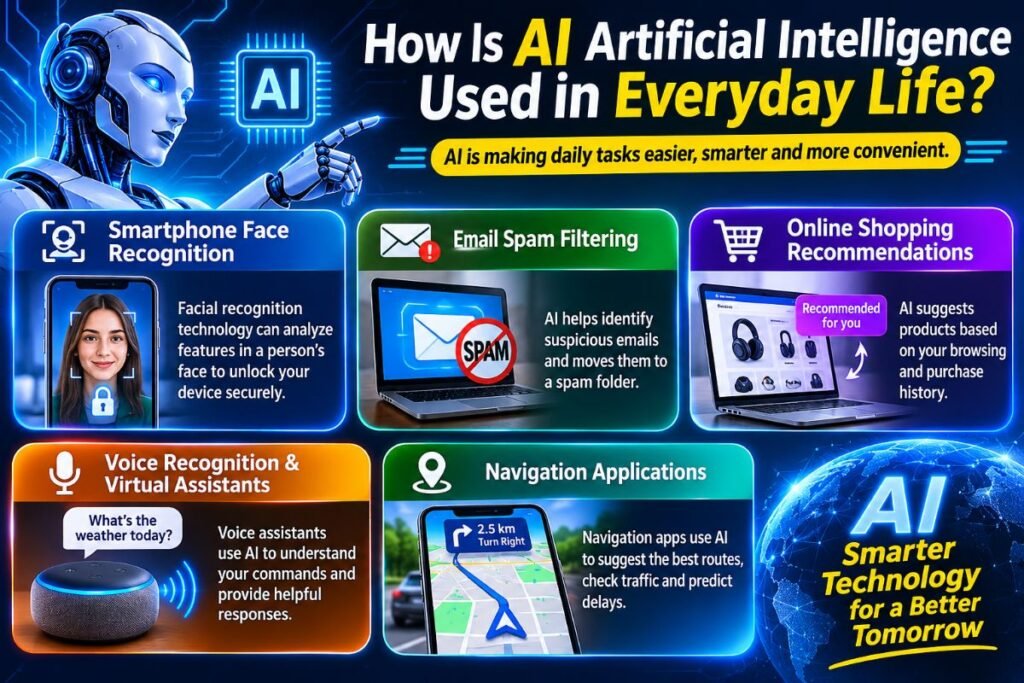
AI applications in daily life are often built into services people already use. Many users interact with these systems without needing to understand the technical processes behind them.
Smartphone Face Recognition
Facial recognition technology can analyze features in a person’s face to support device authentication. When someone tries to unlock a compatible smartphone, the system compares the captured information with the registered facial data.
The exact security method depends on the device and its implementation.
Email Spam Filtering
Email services use automated systems to identify messages that may be unwanted or suspicious. These systems can examine message characteristics, sender information and patterns associated with spam.
A message identified as suspicious may be moved into a spam folder instead of the main inbox.
Online Shopping Recommendations
Shopping platforms can use browsing activity, purchase history and product interactions to recommend items.
For example someone searching for a particular type of laptop may receive suggestions for related accessories or similar products.
Voice Recognition and Virtual Assistants
Voice assistants use speech recognition and language processing technologies to interpret spoken requests.
A user might ask for weather information, set a reminder or request directions. The assistant processes the request and provides a response based on its available features and connected services.
Navigation Applications
Navigation apps can analyze location information, road conditions and traffic data to suggest routes.
AI related prediction systems can help estimate travel conditions and identify possible delays. The accuracy of these suggestions depends on the information available at the time.
What Are the Most Common Applications of AI?
Artificial intelligence is used across different industries to analyze information, automate tasks, recognize patterns and support decisions.
AI in Healthcare
Healthcare organizations can use AI to assist with medical image analysis, patient information management, research and clinical decision support.
For example, an AI system may help identify patterns in medical images that a qualified professional should review. These tools can support healthcare workers but they do not replace professional medical judgment.
AI can also help researchers analyze large datasets when studying diseases or investigating potential treatments.
AI in Education
Educational applications can use AI to provide learning support, explain difficult topics and help teachers organize educational material.
For example, a learning platform may identify subjects where a student needs additional practice and suggest relevant exercises.
Digital learning platforms and educational tools are helping students and teachers access learning resources more effectively. Explore our guide to instructional technology services to understand how technology supports modern education.
Students can also use artificial intelligence tools to summarize study material, understand unfamiliar terms and organize revision plans. However, they should check information against reliable educational sources.
AI in Business
Businesses use AI automation systems to process information, answer common customer questions, analyze sales patterns and support routine operations.
For example, a company may use an AI powered chatbot to respond to basic questions about order status or return procedures.
Employees can then focus on requests that require more detailed assistance or human judgment.
AI in Finance
Financial organizations use AI machine learning systems to examine transactions and identify unusual patterns.
Artificial intelligence is also changing modern banking through fraud detection, transaction monitoring and automated financial services. To explore these technologies in more detail, read our guide to banking technology and its practical applications.
For example, a system may flag a transaction that differs from a customer’s usual activity for further review.
AI data analysis can also support financial forecasting and help organizations examine large amounts of information. Important financial decisions still require suitable oversight.
AI in Transportation
Transportation systems can use AI for route planning, traffic analysis, object recognition and vehicle related automation.
For example, navigation applications can use traffic information to suggest an alternative route when delays are detected.
Autonomous vehicle technology also uses sensors and computer vision to interpret surrounding conditions. Its safe operation requires careful testing and reliable systems.
AI in Entertainment
Streaming platforms can recommend films, music and other content based on user activity and preferences.
In gaming, AI can help control non player characters and support more responsive gameplay experiences.
Generative AI can also assist with creating or editing different forms of digital content.
What Are the Benefits of AI Artificial Intelligence?
AI can improve how people and organizations process information and complete certain tasks. Its benefits depend on the quality of implementation and the problem being addressed.
Faster Data Analysis
AI systems can process large datasets and identify patterns that may be difficult to find manually.
For example, a business can analyze customer activity to understand purchasing trends and make better informed planning decisions.
Automation of Repetitive Tasks
AI automation systems can handle routine activities such as sorting information, processing documents and responding to common questions.
This can reduce the amount of time employees spend on repetitive work and allow them to focus on tasks requiring human judgment.
Better Pattern Recognition
Machine learning models can identify patterns in images, text, transactions and other information.
In healthcare, for example, image analysis systems may help professionals examine medical scans and identify areas that need closer attention.
Improved Availability
Some AI powered applications can operate continuously without requiring the same breaks as human workers.
A customer support chatbot, for example, may answer basic questions outside normal business hours, although complex requests may still require a human representative.
Decision Support
AI can organize information and produce predictions that help people evaluate different options.
For example, a business may use AI data analysis to identify changes in demand before adjusting its inventory plans.
The final decision should consider other relevant information and human expertise.
What Are the Disadvantages and Risks of AI Technology?
Despite its advantages, AI technology has limitations that users and organizations need to understand. Poor implementation, unreliable data and insufficient oversight can create practical problems.
Incorrect AI Generated Information
Generative AI systems can produce answers that sound convincing but contain incorrect details.
For example, an AI writing tool may provide an inaccurate explanation of a technical subject or include information that cannot be verified.
Users should check important facts, statistics, medical information and financial details against reliable sources.
Data Privacy Concerns
AI systems may process personal, business or other sensitive information. If that information is collected, stored or shared without appropriate safeguards, privacy problems can occur.
Users should avoid entering confidential details into AI tools unless they understand the service’s data handling and privacy arrangements.
Algorithmic Bias
AI models can produce unfair results when their training data contains incomplete or biased information.
For example, a recruitment system trained on unrepresentative historical hiring data may produce recommendations that disadvantage certain groups.
Developers need to evaluate training data and test model outcomes to identify and reduce unfair patterns.
High Development and Maintenance Costs
Building and operating advanced AI systems can require computing resources, skilled professionals, data preparation, testing and ongoing maintenance.
The cost depends on the model, application, infrastructure and scale of deployment. Not every organization needs to develop its own AI model; some can use existing services.
Dependence on Training Data
AI models learn from the information used during training. If that information is inaccurate, outdated or unsuitable for the task, the model may produce unreliable results.
A model may also struggle when it receives information that differs significantly from the examples it learned during training.
Human Oversight Requirements
AI systems can make mistakes, misunderstand instructions or produce results that need additional context.
Human oversight is especially important in healthcare, education, finance, recruitment and other areas where decisions can significantly affect people.
Security Vulnerabilities
AI applications and their supporting data can be exposed to security threats. Attackers may attempt to manipulate inputs, access sensitive information or interfere with model behavior.
Organizations need appropriate security controls, monitoring and testing throughout the AI system’s lifecycle.
AI Benefits vs. AI Challenges
Understanding the benefits and challenges of artificial intelligence helps people make informed decisions about its use.
- AI Benefits: Faster data analysis, automation of repetitive tasks, improved pattern recognition, continuous availability, decision support and personalized services.
- AI Challenges: Incorrect predictions, job disruption, data bias, security risks, limited transparency and privacy concerns.
AI works best when its capabilities match the task and its limitations are properly managed. Important medical and financial decisions still require professional review.
Can Artificial Intelligence Think Like Humans?
Artificial intelligence can perform tasks that appear intelligent, including recognizing patterns, processing language solving certain problems and generating responses.
However, performing these tasks does not establish that an AI system thinks or experiences the world in the same way a human does.
Human intelligence includes experience, emotions social understanding, physical interaction and consciousness. AI can simulate communication and problem solving but this does not prove genuine human like awareness.
Most existing AI belongs to the Narrow AI category. It is designed to perform particular tasks rather than possess general human intelligence.
Can Artificial Intelligence Replace Human Jobs?
AI can automate certain tasks that people currently perform, which may change the responsibilities required in different occupations.
For example, automated systems can help organize documents, process routine requests, analyze information and generate basic content. These capabilities may reduce the need for some repetitive activities.
However, many jobs also involve communication, practical experience, responsibility, creativity and decisions that require human judgment.
The effect of AI on employment will vary by occupation, industry and how organizations adopt the technology. In many situations, AI can support workers rather than completely replace their roles.
Learning how to use relevant AI tools can help people adapt to changing workplace requirements.
Is Artificial Intelligence Safe to Use?
AI can be useful but its safety depends on the application, the information it processes and the safeguards in place.
For everyday tasks such as organizing notes or generating writing ideas, users can benefit from AI while checking the results. Higher risk uses require stronger testing, privacy protection and human supervision.
A responsible approach includes avoiding unnecessary sharing of personal information, verifying important answers and understanding the limitations of each tool.
Organizations should also evaluate AI systems for accuracy, fairness, security and reliability before using them in important processes.
How Can Everyday Users Use AI Responsibly?
Artificial intelligence tools can help with research, learning, writing, planning and productivity. Getting useful results requires clear instructions and careful review.
For research, users can ask AI to explain unfamiliar concepts or suggest topics to investigate. They should verify important claims using reliable sources rather than treating generated answers as final evidence.
For writing and learning, AI can help organize ideas, explain difficult subjects and improve clarity. Users should review the output to ensure it is accurate and reflects their intended meaning.
For planning and productivity, AI can help create task lists organize schedules or summarize information. Avoid sharing passwords, financial details, confidential documents or sensitive personal information without understanding the tool’s privacy protections.
What Is the Future of AI Artificial Intelligence?

AI development continues to influence software, research, business operations, education and other areas. Improvements in machine learning, neural networks, computing infrastructure and generative artificial intelligence are supporting new types of applications.
Generative AI is making it possible for systems to produce text, images, audio, video and code from user instructions. AI powered applications are also being developed to support more complex workflows and assist people with different tasks.
However, future capabilities and their impact should not be treated as guaranteed outcomes. Technical limitations, safety requirements, privacy concerns, regulation and public trust will influence how AI innovation develops.
The future of artificial intelligence will depend not only on more capable models but also on responsible development, reliable information, appropriate human oversight and practical benefits for users.
Conclusion
AI artificial intelligence enables computers to learn from information, recognize patterns, process language and support decisions. Technologies such as machine learning, deep learning, neural networks and generative AI power many modern applications.
Its benefits include faster data analysis, automation, pattern recognition and decision support. However, inaccurate outputs, privacy concerns, bias, security risks and the need for human oversight remain important challenges.
Understanding how AI works and where its limitations exist helps people use it more responsibly. Its value depends on applying the technology to suitable tasks while keeping accuracy, safety and human judgment in mind.
FAQs
What is AI artificial intelligence in simple words?
AI artificial intelligence is technology that enables computers to perform tasks associated with human intelligence, such as learning from data, recognizing patterns, understanding language and making predictions.
Is artificial intelligence the same as machine learning?
No. Artificial intelligence is the broader field of creating systems that perform intelligent tasks. Machine learning is a part of AI that allows systems to learn patterns from data and use them to make predictions or decisions.
Does AI always provide accurate answers?
No. AI systems can produce incorrect information, biased predictions or incomplete responses. Users should verify important information through reliable sources, especially when it relates to health, finance, safety or legal matters.
Can artificial intelligence replace human workers?
AI can automate certain tasks and change job responsibilities but it does not automatically replace every role. Many occupations require human judgment, communication, practical skills and responsibility that automated systems cannot fully provide.
What are the main limitations of AI?
Major limitations include inaccurate outputs, dependence on training data, algorithmic bias, privacy concerns, security vulnerabilities, development costs and the need for human oversight.