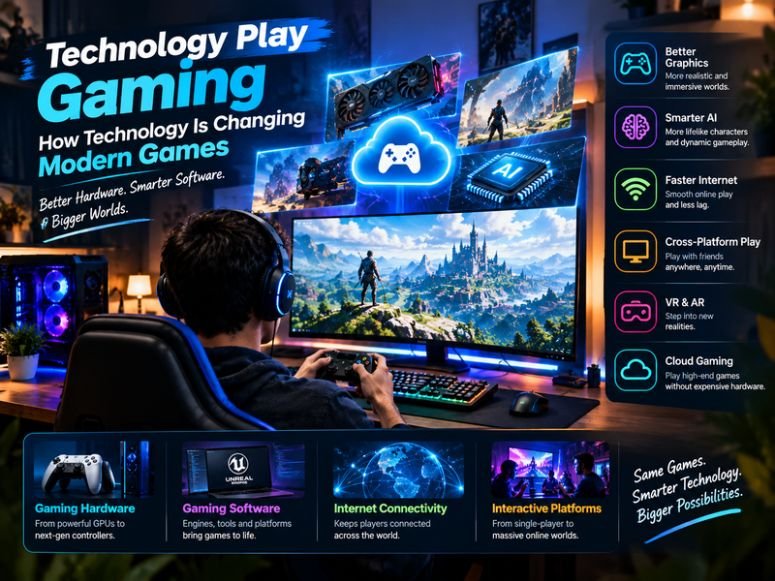
Technology play gaming describes how digital technology shapes the way people play, develop, access and experience video games. It includes gaming hardware software, internet connectivity, graphics systems, artificial intelligence and interactive platforms.
Modern gaming technology does more than improve graphics. It helps developers create interactive worlds, connects players across different devices and supports experiences ranging from mobile puzzles to competitive esports and virtual reality.
Understanding technology play gaming can help beginners choose suitable gaming systems, improve performance, understand new gaming features and make informed decisions about hardware software and online services.Explore our gaming guides for more gaming topics, tips and useful guides
What Is Technology Play Gaming?
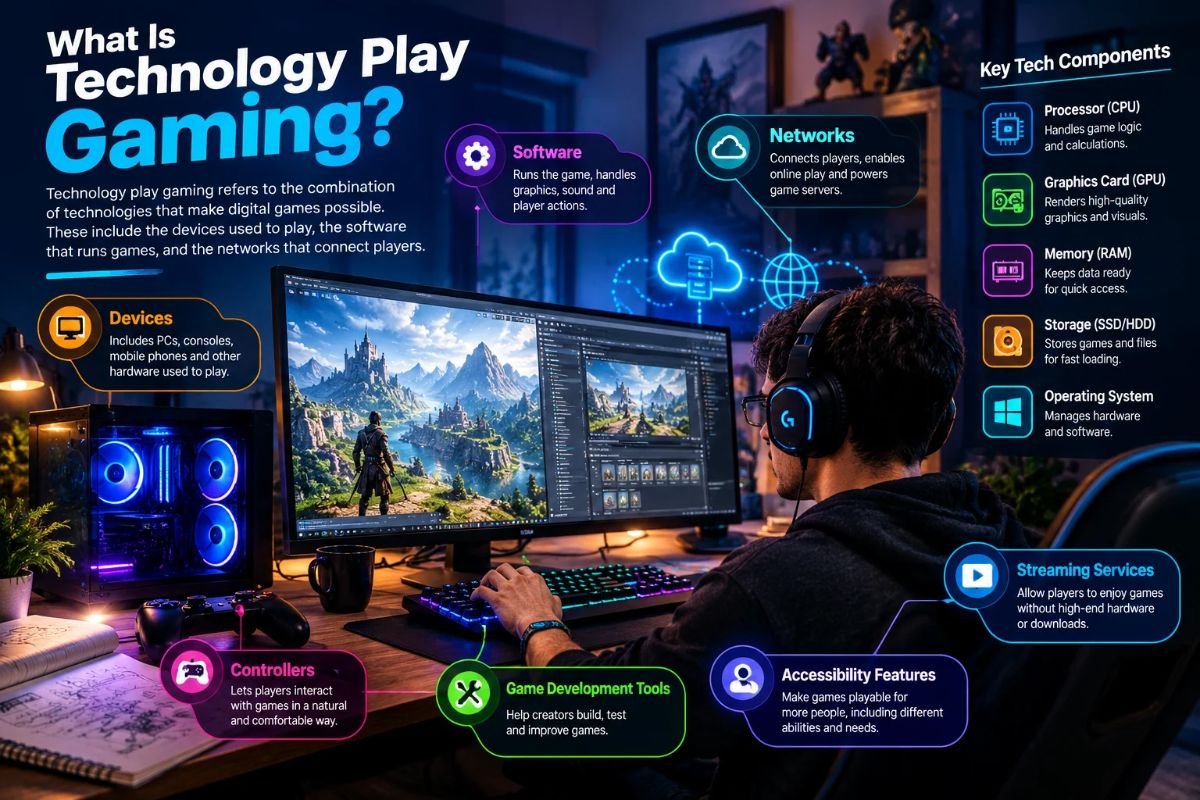
Technology play gaming refers to the combination of technologies that make digital games possible. These technologies include the devices used to play, the software that runs games and the networks that connect players.
For example, a gaming PC uses a processor, graphics card, memory, storage and an operating system to run a game. The game itself uses software systems to display environments, process player actions, manage sound and calculate what happens during gameplay.
Gaming technology also includes online servers, game development tools, controllers, accessibility features and streaming services. Each component has a different purpose, but they work together to create a complete gaming experience.
What Is Gaming Technology in Simple Terms?
Gaming technology is the equipment and software that allow people to create and play video games. A smartphone running a mobile game, a console connected to a television and a computer running a multiplayer game are all examples.
Some technologies operate directly on the player’s device. Others work through internet connected servers or cloud platforms. The combination depends on the game, the device and the features being used.
How Technology Play Gaming Works?
Modern video games combine several technical processes whenever a player starts a game, moves a character or interacts with an object. The game receives input, processes the action, updates the game world and displays the result.
When a player presses a controller button, the processor handles game logic, while the graphics system generates visuals and audio systems produce sound. Network technology connects the game to remote servers when online features are used.
These processes happen repeatedly during gameplay. Their efficiency affects responsiveness, visual quality, loading times and overall stability.
How Do Game Engines Work?
A game engine is a software framework that provides tools for building and running video games. Developers use it to manage graphics, animation sound, physics, input controls and other game systems.
Game engines can reduce the need to build every technical feature from scratch. Developers can create environments, add characters, test gameplay and optimize performance within a shared development framework.
Different engines support different workflows and requirements. The most suitable choice depends on the game’s design, target platforms, team experience, performance needs and available development tools.
The Role of Game Physics and Animation
Game physics systems help simulate movement, collisions, gravity and interactions between objects. For example, a racing game may calculate how a vehicle responds to acceleration, braking and contact with other objects.
Animation technology makes characters and objects move. Developers may use hand created animations, motion capture, procedural techniques or combinations of these methods.
When physics and animation work together effectively, movement feels more consistent and believable. However, realistic results also depend on good design, testing and optimization.
Gaming Hardware and Software Explained
Gaming hardware and software perform different but connected roles. Hardware provides the physical computing resources, while software tells those resources what to do.
Choosing suitable hardware can improve performance, but a powerful system alone cannot correct every software problem. Game optimization, drivers, system settings and hardware compatibility also influence the final experience.
What Is the Role of CPU and GPU in Gaming?
The central processing unit or CPU, handles many general computing tasks. In games, it can manage game logic, artificial intelligence calculations, physics, background processes and instructions related to the game world.
The graphics processing unit or GPU, specializes in processing graphics and parallel computing tasks. It helps render characters, environments, lighting, shadows, textures and other visual elements.
Both components matter, but their relative importance depends on the game. A visually demanding game may rely heavily on the GPU, while a simulation with many active characters may place greater demands on the CPU.
How Do Graphics Cards Improve Gaming Performance?
A graphics card helps render game scenes and determine how smoothly they appear on the screen. Its capabilities, available video memory and compatibility with the game influence the resolutions and graphics settings a system can handle.
Advanced graphics technologies can improve lighting, reflections, shadows and image quality. Features such as upscaling and frame generation may also increase perceived smoothness on supported hardware and games.
These features do not guarantee better results in every situation. Performance depends on the graphics card, processor, game engine, settings, resolution and implementation of the technology.
Gaming Memory, Storage and Cooling
Memory allows a computer to keep active game data and other information readily available. Insufficient memory can contribute to slowdowns when a game and background applications require more resources than the system can comfortably provide.
Storage affects installation, loading and file access. Solid state drives generally provide faster access than traditional hard disk drives, although actual loading improvements vary by game and system configuration.
Cooling is equally important because processors and graphics cards generate heat during demanding workloads. Poor cooling may cause components to reduce their operating speeds, affecting performance and stability.
How Modern Gaming Technology Improves Graphics and Performance?
Modern gaming technology allows developers to build detailed environments, responsive controls, complex simulations and more immersive sound. However, graphics quality is only one part of performance.
A game may look impressive but still feel uncomfortable if controls respond slowly, frame rates fluctuate or online connections become unstable. Good gaming performance depends on balancing visual quality, responsiveness, reliability and the capabilities of the device.
What Is FPS and Why Does It Matter?
Frames per second, commonly called FPS, measures how many frames a game displays each second. Higher frame rates can make movement appear smoother and can improve responsiveness, particularly in fast paced games.
A stable frame rate is often more useful than a high number that frequently drops. Sudden fluctuations can make movement feel inconsistent, even when the average FPS appears reasonable.
The ideal target depends on the game, display, hardware and player preferences. Competitive games may benefit from higher frame rates, while slower paced games may remain enjoyable at lower, stable rates.
How Does Internet Latency Affect Gaming?
Latency is the time it takes for data to travel between a device and another point in a network. In online gaming, higher latency can delay the communication between a player’s actions and the game server’s response.
Ping is commonly used to describe round trip network latency. Lower ping generally supports more responsive online play, although server performance, packet loss and network stability also matter.
Players can sometimes improve connectivity by using a wired connection, reducing unnecessary network traffic, selecting an appropriate server region or improving Wi Fi conditions. These steps cannot eliminate every delay because some factors depend on the internet provider and the game server.
How to Improve Gaming Performance Through Technology?
Start by checking the game’s recommended system requirements and confirming that the hardware meets them.If you’re planning a PC setup, our gaming PC and monitor guide can help you understand the main hardware considerations.
Adjusting resolution, shadows, textures and other demanding graphics settings can help balance image quality with frame rate.
Keeping operating system updates and compatible graphics drivers current may resolve certain performance or stability problems. Closing unnecessary background applications can also free system resources.
If problems continue, monitor temperatures, memory usage, storage space and network conditions. Identifying the actual cause is more useful than replacing hardware without checking whether it is responsible for the problem.
AI in Gaming and Game Technology Innovations
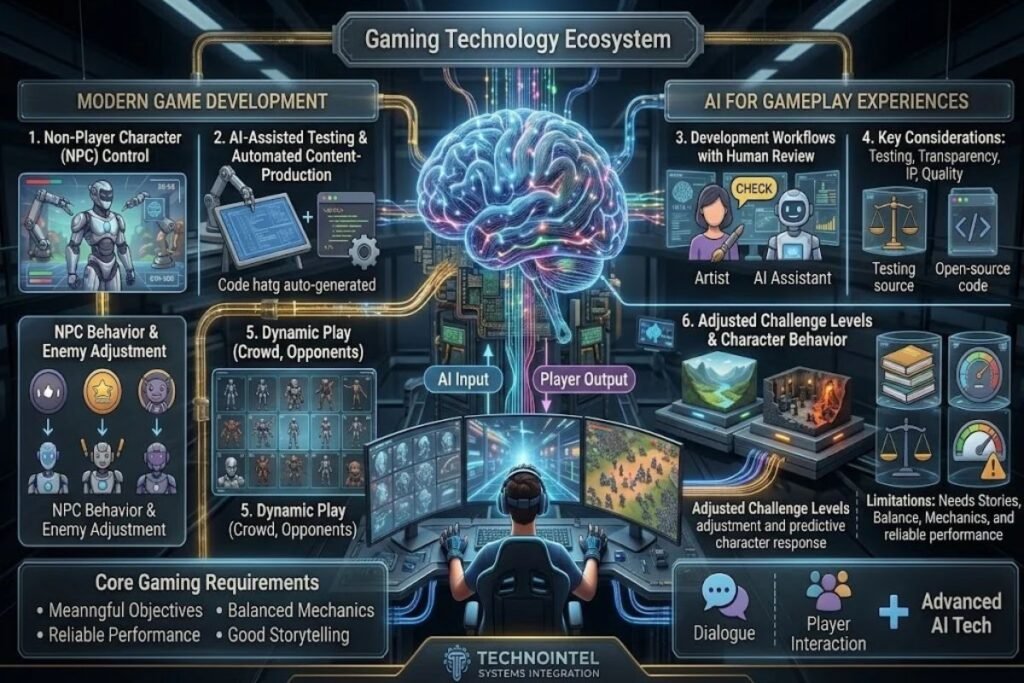
Artificial intelligence supports several parts of modern game development and gameplay. Developers can use AI techniques to control non player characters, adjust enemy behavior, assist testing and support selected content production tasks.
AI controlled characters may respond to the player’s actions according to predefined rules, behavior systems or more advanced models. The level of adaptability depends on how the system has been designed and implemented.
AI tools can also assist with development workflows, but their output still requires human review. They may introduce errors, inconsistent behavior or content that does not fit the game’s style and requirements.
How Does AI Change Gaming Experiences?
AI can help make opponents react differently to player actions, manage simulated crowds or support dynamic gameplay systems. In some games, it can help adjust challenge levels or improve the behavior of characters.
However, AI does not automatically make a game more engaging. Players still need meaningful objectives, balanced mechanics, good storytelling and reliable performance.
Developers must also consider testing, transparency, intellectual property and the quality of AI generated material. These considerations become particularly important when AI affects dialogue, player interactions or large amounts of game content.
Virtual Reality and Augmented Reality Gaming
Virtual reality gaming places players inside a digitally created environment using a headset and, in many cases, motion controllers or hand tracking. Players can look around and interact with the virtual world through supported input methods.
Augmented reality gaming takes a different approach by placing digital elements over a view of the physical environment. Depending on the device, this may involve a phone camera, location information, sensors or specialized glasses.
Both technologies offer alternative ways to interact with games. Their usefulness depends on the experience being created, device compatibility, comfort and the player’s available space.
Benefits and Limitations of VR Gaming
VR can create a stronger sense of presence because the player can look around and interact with a three dimensional environment. It can be particularly suitable for simulation, rhythm, exploration and selected action games.
However, VR equipment may cost more than a standard gaming setup. Some players experience discomfort or motion sickness, while certain games require sufficient physical space.
Headset fit, tracking quality, system requirements and available games should be considered before purchasing equipment. VR is an additional gaming option rather than a necessary upgrade for every player.
How Augmented Reality Is Used in Games?
AR games combine digital objects with a view of the real world. A game may use a device camera and supported sensors to place characters, objects or interactive elements within the player’s surroundings.
This approach can connect gameplay with physical locations or spaces. However, AR experiences depend on the device’s sensors software compatibility, lighting conditions and the environment in which the game is used.
Cloud Gaming Technology vs Traditional Gaming
Cloud gaming technology runs a game on remote computing hardware and streams the resulting video to a player’s device. The player’s controls are sent back over the network, allowing the remote system to process gameplay.
Traditional local gaming runs most of the game’s processing directly on a console, PC or mobile device. The two approaches can provide similar types of gameplay, but they have different hardware and connectivity requirements.
Cloud gaming may allow compatible devices to access demanding games without installing or processing the entire game locally. However, it requires a suitable internet connection and access to a service that supports the desired game and device.
Local gaming can provide more predictable responsiveness without depending on continuous cloud streaming. It may also work offline when the game supports offline play and does not require online authentication.
Neither approach is automatically better for everyone. The choice depends on internet reliability, device capability, game availability, subscription requirements, portability and personal preferences.
Learn more about how cloud gaming works and how it compares with traditional gaming.
Online Multiplayer Technology and Gaming Network Security
Online multiplayer technology connects players and synchronizes game activity across devices. Game servers may manage player accounts, matchmaking, shared game states, communication and other online functions.
Reliable networking is important because each player needs a consistent view of the game. Developers use synchronization methods, server side validation and other systems to reduce problems caused by delayed or conflicting information.
How Do Anti Cheat Systems Work?
Anti cheat technology helps detect, prevent or respond to unauthorized tools and unfair gameplay. Depending on the game, systems may examine game behavior, verify actions on servers, detect prohibited software or investigate suspicious activity.
No anti cheat system can guarantee that cheating will never occur. Developers must balance detection, fair enforcement, compatibility and player privacy.
Players should use legitimate game installations, avoid unauthorized cheats and keep their devices protected. Installing suspicious software can expose accounts and personal information to unnecessary risks.
Gaming Security and Privacy
Online games may collect information such as account details, gameplay activity, device information and communication data. The specific information depends on the game, platform and applicable privacy practices.
Players can reduce avoidable risks by using strong, unique passwords and enabling two factor authentication when available. They should also review privacy settings and be cautious about sharing personal information through chats or public profiles.
Parents and guardians may need to review communication controls, purchase permissions and age appropriate settings for younger players. Security features are most useful when they are understood and configured correctly.
Mobile Gaming Technology and Compatibility
Mobile gaming technology allows people to play on smartphones and tablets without needing a dedicated console or gaming computer. Modern mobile devices combine processors, graphics capabilities, touchscreens, sensors and wireless connectivity in portable systems.
Games vary significantly in their requirements. Simple titles may run comfortably on entry level devices, while demanding 3D games can require more processing power, memory and storage.
Compatibility should be checked before installing a game. Supported operating system versions, available storage, device performance and regional availability may affect whether a title can run properly.
Battery life and heat are also practical considerations. Reducing graphics settings, limiting background activity and avoiding excessive heat can help make longer mobile gaming sessions more comfortable.
Players who want to run Android games on a computer can explore our BlueStacks alternatives guide to compare available emulator options.
Benefits and Limitations of Modern Gaming Technology
Gaming technology can make games more accessible, visually detailed, interactive and socially connected. Online services allow people to play together across distances, while modern development tools help creators build complex experiences.
Accessibility features such as remappable controls, subtitles, adjustable text and visual settings can help more people participate. Support varies between games so players should check which options are available before choosing a title.
Technology also introduces limitations. Powerful hardware can be expensive, online games depend on network quality and frequent updates may require additional time and storage.
Privacy concerns, compatibility problems, subscriptions and in game purchases can also affect the experience. Evaluating these trade offs helps players choose technology that fits their needs instead of assuming that the newest option is always the best.
Esports Technology and Gaming Careers
Esports technology supports organized competitive gaming, from individual players’ equipment to tournament networks and broadcasting systems. Gaming computers or consoles, monitors, controllers, headsets, servers and reliable internet connections can all contribute to competitive play.
Tournament organizers may also use streaming equipment, production software, communication systems and tools for managing matches. The exact setup depends on the game, event format and competition requirements.
Gaming technology also creates opportunities for people interested in building and supporting games. Relevant career paths include game programming, technical art, animation, quality assurance, network engineering sound design and game production.
Other roles focus on accessibility, player support, security or live operations. These careers require different combinations of technical knowledge, creative skills, communication and practical experience.
Beginners can explore game engines, programming fundamentals, animation tools or testing workflows to identify an area that suits their interests. Building small projects and learning how to test them provides a practical way to develop skills.
The Future of Gaming Technology
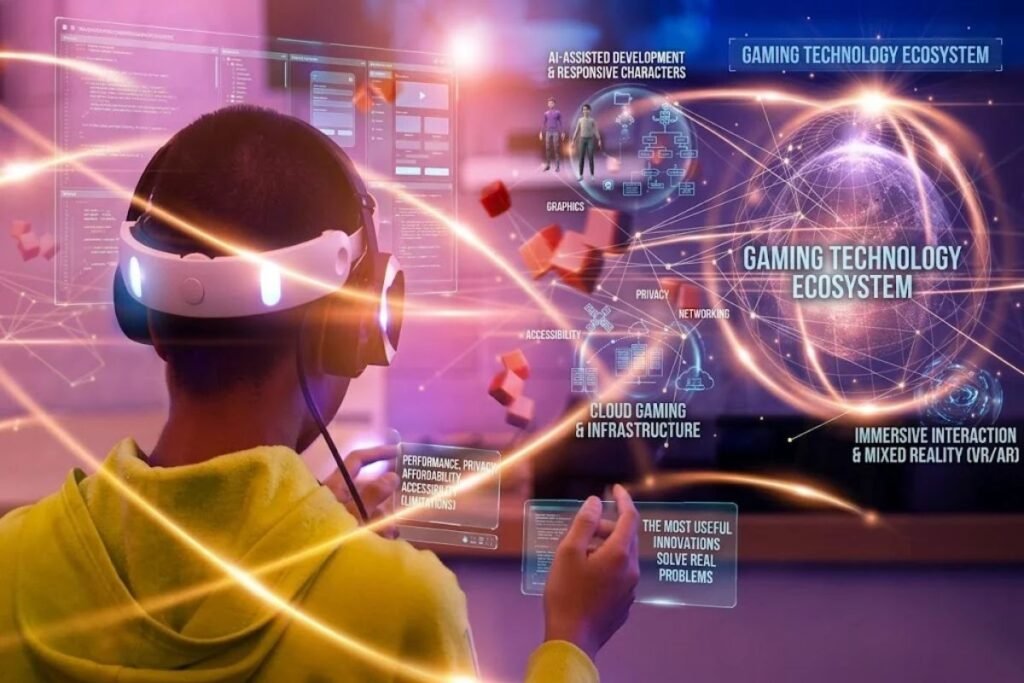
The future of gaming technology may involve continued improvements in graphics, AI assisted development, cloud infrastructure, networking and immersive interaction. The pace and impact of these changes will depend on technical progress, cost, adoption and player preferences.
AI may support more responsive characters and development workflows, while VR and AR may create new ways to experience interactive environments. Cloud gaming may also provide greater flexibility where suitable services and internet connections are available.
These technologies still face limitations involving performance, privacy, affordability, accessibility and implementation. Not every new feature will become standard and some experiences may remain better suited to traditional hardware.
The most useful innovations will be those that solve real problems for players or developers. Better responsiveness, stable performance, accessible controls, reliable security and thoughtful game design will remain important alongside new visual and interactive features.
Conclusion
Technology play gaming brings together the hardware software and networks that shape modern video games. From graphics cards and game engines to AI, cloud gaming and online multiplayer systems, each technology contributes to a different part of the experience.
Understanding the benefits and limitations of gaming technology helps players choose suitable devices, improve performance, protect their accounts and explore new ways to play. Developers also use these tools to build, test and maintain interactive experiences.
As gaming technology develops, practical performance, accessibility, security and thoughtful design will remain essential. The right setup is the one that meets the player’s needs without adding unnecessary cost or complexity.
FAQs
What is technology play gaming?
Technology play gaming describes the hardware software, networks and digital tools used to develop and experience video games. It includes gaming PCs, consoles, mobile devices, game engines, AI, cloud services and online multiplayer systems.
What technologies are used in modern gaming?
Modern gaming may use CPUs, GPUs, memory, storage, game engines, graphics rendering, physics simulation, animation, AI, audio systems and network technology.
How can technology improve gaming performance?
Performance can improve by matching hardware to the game’s requirements, adjusting graphics settings, maintaining compatible drivers and checking system temperatures.
Is cloud gaming better than traditional gaming?
Cloud gaming reduces the need for powerful local hardware but depends on internet quality, service availability and supported games. Traditional gaming can offer more predictable local performance and may support offline play, depending on the title.
What is the future of gaming technology?
Gaming technology may continue to develop through AI assisted tools, improved graphics, cloud services, VR, AR and better multiplayer systems.