Walking into digital marketing without knowing the terminology is like trying to navigate a new city without a map. Every conversation, report and strategy document assumes you already know what CTR, ROAS and DA mean.
Beginners often skip vocabulary or rely on technical jargon that makes simple concepts complex. According to HubSpots 2026 Marketing Report, 67% of beginners cite unclear terminology as their biggest obstacle to understanding campaign performance.
This guide solves that problem. You will find every major digital marketing term explained in plain language organized by category so you can reference exactly what you need without reading through content that does not apply to your current situation.
Core SEO and Organic Search Terminology
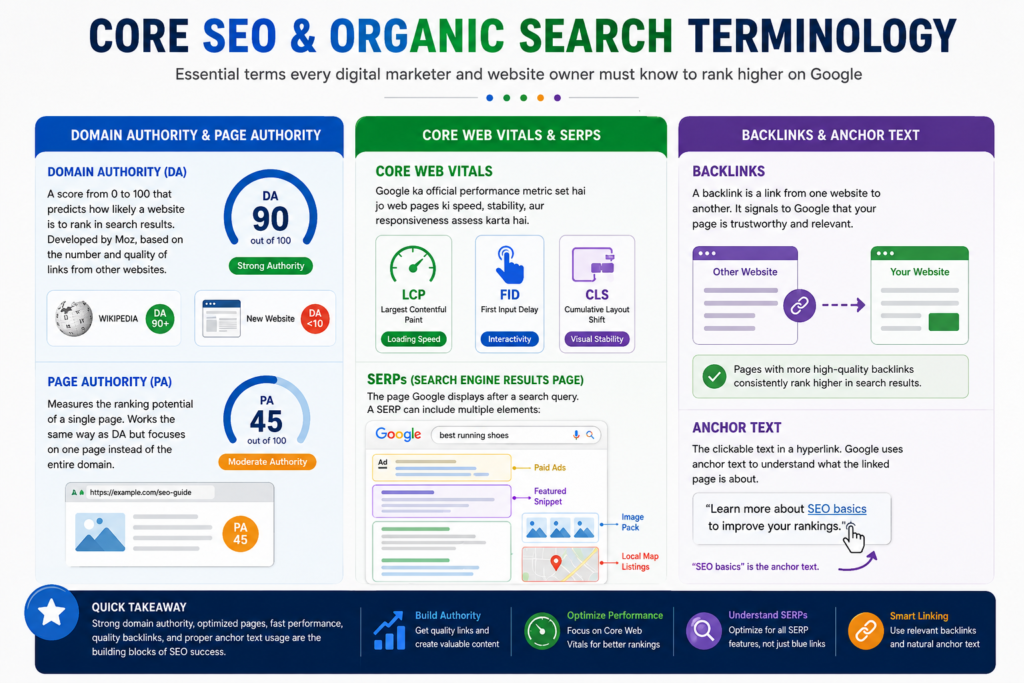
SEO or Search Engine Optimization is the practice of improving your website so it appears higher in Google and other search engine results without paying for placement. Understanding its vocabulary is the foundation of all digital marketing knowledge.
Domain Authority and Page Authority
Domain Authority is a score from 0 to 100 that predicts how likely a website is to rank in search results. It was developed by Moz and is based on the number and quality of links pointing to your site from other websites.
Page Authority works the same way but measures the ranking potential of a single page rather than the whole website. A new website typically starts with a Domain Authority below 10 while established sites like Wikipedia score above 90.
Core Web Vitals and SERPs
Core Web Vitals Google ka official performance metric set hai jo web pages ki speed, stability, aur responsiveness assess karta hai. Iske teen main metrics hain: Largest Contentful Paint (loading speed), First Input Delay (interactivity), aur Cumulative Layout Shift (visual stability).
SERP stands for Search Engine Results Page. It refers to the page Google displays after someone types a search query. A SERP can include organic results, paid ads, featured snippets, image packs and local map listings all on the same page.
Backlinks and Anchor Text
A backlink is a link from one website to another. When a reputable website links to your content it signals to Google that your page is trustworthy and relevant. According to Ahrefs, pages with more high quality backlinks consistently rank higher than pages with fewer links across almost every competitive keyword category.
Anchor text is the clickable text in a hyperlink. If a sentence reads “learn more about SEO basics” and the phrase “SEO basics” is the link then “SEO basics” is the anchor text. Google reads anchor text to understand what the linked page is about.
Paid Advertising and PPC Terminology
PPC stands for Pay Per Click. It is an advertising model where you pay only when someone clicks your ad rather than paying for the ad to simply appear on screen. Google Ads and Meta Ads are the two largest PPC platforms globally.
CPC, CPM and CPA Explained
CPC stands for Cost Per Click. It is the amount you pay each time someone clicks your ad. If your campaign budget is $100 and 50 people click your ad your CPC is $2.
CPM stands for Cost Per Mille which means cost per one thousand impressions. An impression counts every time your ad appears on a screen regardless of whether anyone clicks it. CPM is most commonly used in brand awareness campaigns where visibility matters more than direct clicks.
CPA stands for Cost Per Acquisition. It measures advertising spend to generate a customer or conversion. According to WordStream’s 2026 benchmarks, the average CPA on Google Ads is approximately $56 for search campaigns, though this varies by industry and competition.
Return on Ad Spend and ROI
ROAS stands for Return on Ad Spend. It measures how much revenue you generate for every dollar spent on advertising. A ROAS of 4 means you earn $4 in revenue for every $1 you spend on ads.
ROI stands for Return on Investment. It is a broader measurement that factors in all costs not just ad spend including creative production, agency fees and platform costs. While ROAS focuses purely on revenue against ad budget ROI gives a more complete picture of overall campaign profitability.
Social Media and Content Marketing Glossary
Social media marketing involves using platforms like Instagram, TikTok, LinkedIn and YouTube to reach and engage your target audience. Its terminology is specific and often confusing for beginners who are new to platform based marketing.
Engagement Rate, Reach and Impressions
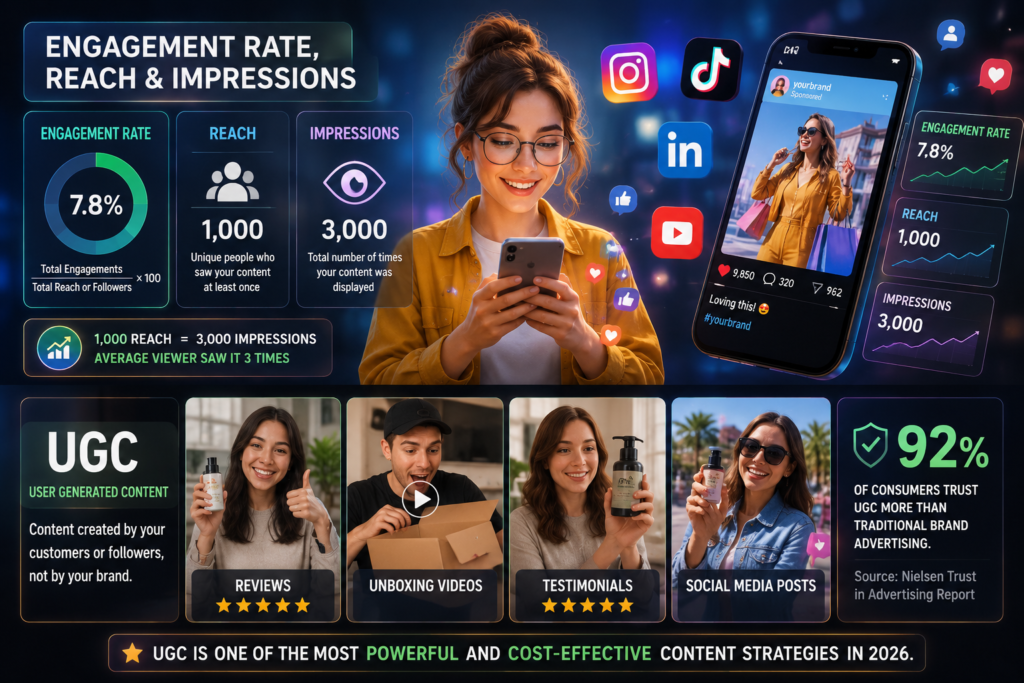
Engagement rate measures how actively your audience interacts with your content. It is calculated by dividing total engagements (likes, comments, shares, saves) by total reach or followers and multiplying by 100 to get a percentage.
Reach refers to the number of unique people who saw your content at least once. Impressions count the total number of times your content was displayed including multiple views by the same person. A post with 1000 reach and 3000 impressions means the average viewer saw it three times.
UGC: User Generated Content
UGC stands for User Generated Content. It refers to any content created by your customers or followers rather than by your brand itself. Reviews, unboxing videos, testimonials and social media posts featuring your product are all forms of UGC.
According to Nielsen’s Trust in Advertising Report, 92% of consumers trust UGC more than traditional brand advertising. This makes UGC one of the most powerful and cost effective content strategies available to businesses of any size in 2026.
Email Marketing and CRO Terminology
Email marketing remains one of the highest returning digital channels available. According to Litmus, email marketing generates an average return of $36 for every $1 spent making it more efficient than most social media and PPC channels.
Open Rate and Click Through Rate
Open rate is the percentage of email recipients who open your email. It is calculated by dividing the number of opens by the number of emails delivered. Industry averages vary but a 20% to 30% open rate is generally considered healthy across most sectors.
CTR or Click Through Rate in email marketing measures the percentage of email recipients who click at least one link inside your email. It is distinct from the CTR used in paid advertising though both measure the proportion of people who take an action after seeing your content.
Lead Magnet and Conversion Funnel
A lead magnet is a free resource offered to website visitors in exchange for their email address. Common lead magnets include ebooks, checklists, templates, free trials and discount codes. The goal is to attract genuinely interested potential customers into your email list.
A conversion funnel is the journey a potential customer takes from discovering your brand to completing a desired action. It typically has three stages: awareness where they learn about you, consideration where they evaluate your offer and decision where they convert.
Important Marketing Metrics Every Beginner Must Know
Beyond platform specific terms there are universal marketing metrics that apply across every channel and campaign type. These numbers tell you whether your marketing is actually working.
- Bounce Rate
- Session Duration
- Conversion Rate
- Customer Lifetime Value (CLV)
- Churn Rate
- A/B Testing
AEO, GEO and Emerging Digital Marketing Terms for 2026
The vocabulary of digital marketing is expanding rapidly in 2026 as AI-driven search changes how content is discovered and ranked, making the ability to master prompt change an essential skill for creators.
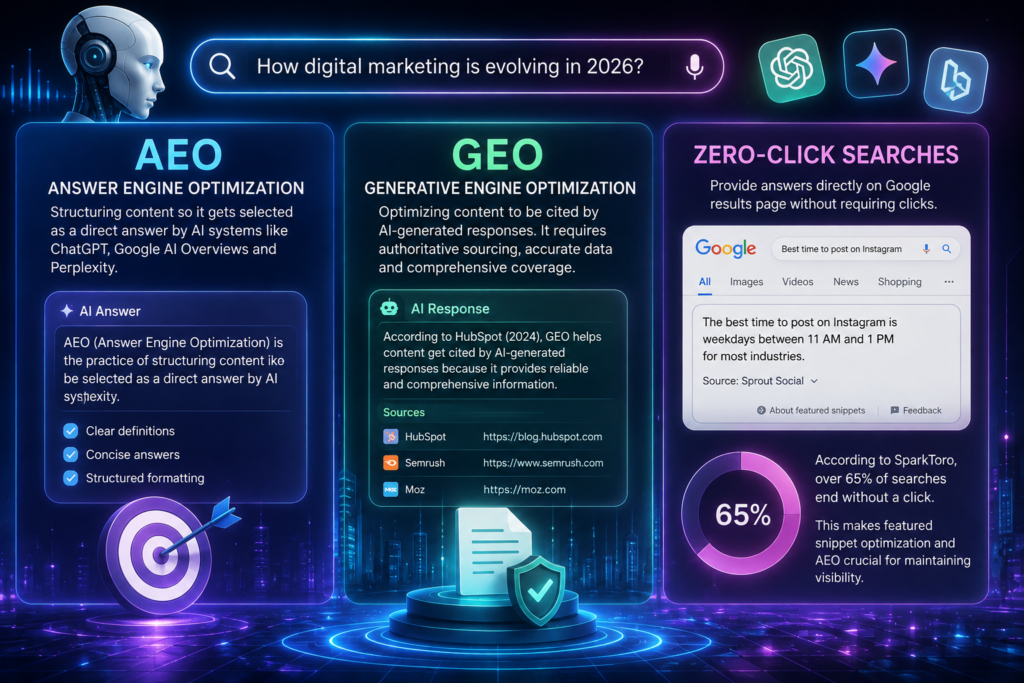
AEO stands for Answer Engine Optimization. It refers to the practice of structuring content so it gets selected as a direct answer by AI systems like ChatGPT, Google AI Overviews and Perplexity. AEO focuses on clear definitions, concise answers and structured formatting rather than traditional keyword placement.
GEO or Generative Engine Optimization, is the practice of optimizing content to be cited by AI generated responses. It requires authoritative sourcing, accurate data and comprehensive coverage to give AI platforms confidence in citing your work.
Zero click searches provide answers directly on Google results page without requiring clicks. According to SparkToro, over 65% of searches end without a click making featured snippet optimization and AEO crucial for maintaining visibility.
Conclusion
Digital marketing terminology is not just vocabulary. It is the shared language that lets you understand your data, collaborate with teams and make decisions that actually improve your results.
Start with the terms most relevant to your current work. If you are running Google Ads focus on CPC, ROAS and conversion rate first. If you are building an organic content strategy prioritize SEO terms like domain authority, backlinks and Core Web Vitals.
Return to this guide as your marketing responsibilities grow. The terminology expands with your knowledge and each new term you understand makes the next one easier to grasp.
FAQs
What is digital marketing terminology and why does it matter?
Digital marketing terminology is essential for SEO, advertising and content strategy. Understanding these terms helps you interpret campaign data, communicate effectively and make informed decisions. Without this foundation, evaluating marketing performance becomes difficult and time consuming.
What is the most important digital marketing term for beginners?
Conversion rate is the single most important term for beginners because it directly measures whether your marketing is achieving its goal. It tells you what percentage of visitors are completing the action you want whether that is a purchase, sign up or download.
What is the difference between SEO and SEM?
SEO improves search rankings organically without paid placement while SEM utilizes paid search advertising for immediate visibility. Both increase search presence but SEO builds long term authority while SEM delivers paid traffic.
What does CTR mean in digital marketing?
CTR stands for Click Through Rate. It measures the percentage of people who click on your ad, link or email after seeing it. It is calculated by dividing the number of clicks by the number of impressions or deliveries and multiplying by 100.
How does digital marketing terminology change over time?
Digital marketing terminology evolves as new platforms, technologies and strategies emerge. Terms like AEO and GEO barely existed before 2024 and are now central to content strategy in 2026. Staying current requires following industry publications like Search Engine Journal, HubSpot Blog and Moz regularly.
Is digital marketing terminology the same across all industries?
This is a common misconception. While core terms like CTR, ROI and conversion rate are universal, industry specific variations exist in how metrics are defined and measured. An ecommerce brand defines conversion as a purchase while a SaaS company may define it as a free trial sign up.