
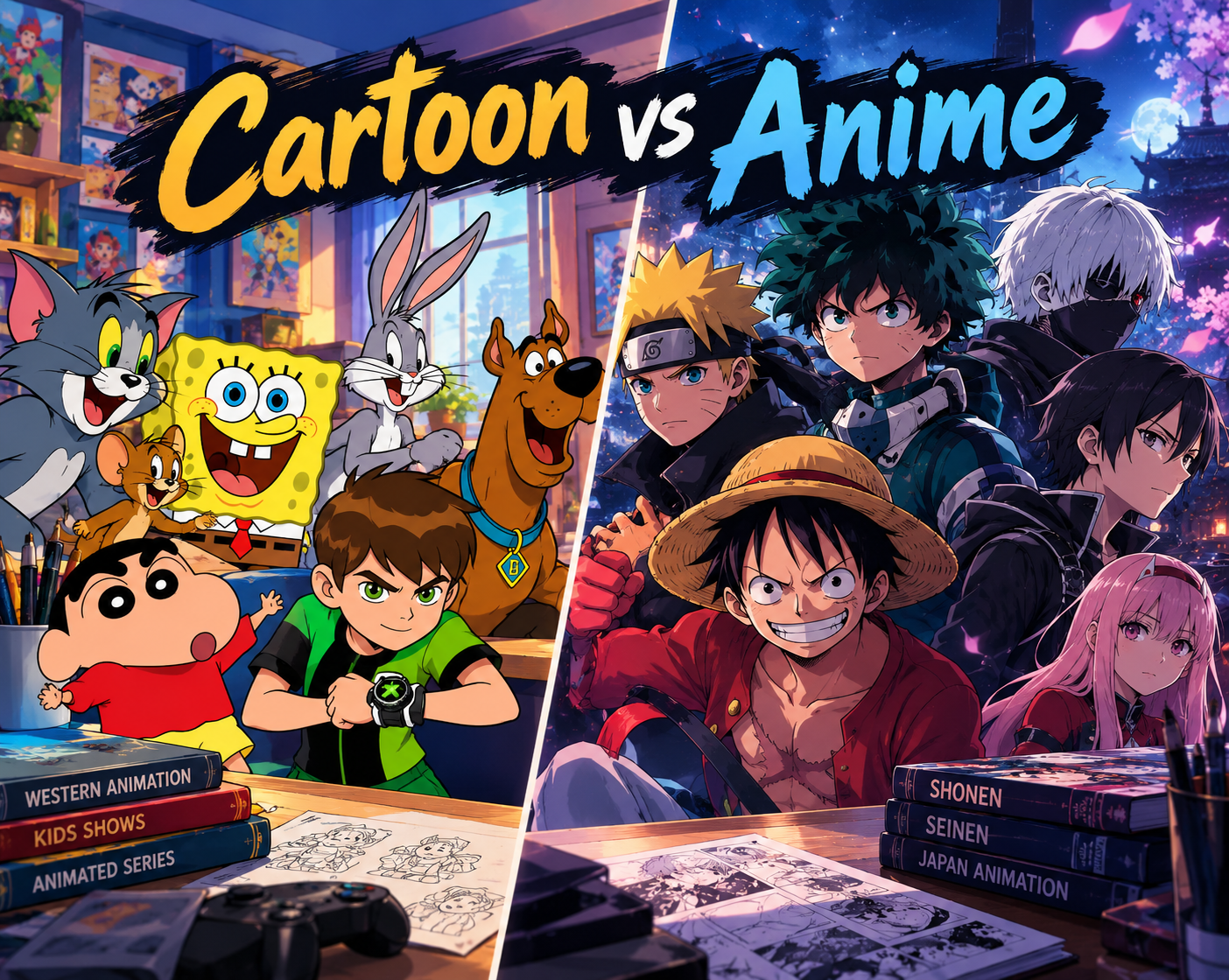
Ask ten people to define anime and you’ll likely get ten different answers. Some call it a genre, others call it a style and plenty just say Japanese cartoons and move on.
That confusion is exactly why this comparison keeps trending. This guide breaks down where anime and cartoons actually diverge, from origin to art style to how their stories are structured.
By the end, you’ll be able to place any show into the right category without hesitation, including the ones that confuse everyone, from Avatar to Doraemon.
Quick Answer
Anime refers specifically to animation produced in Japan, known for expressive art styles and serialized storytelling across genres. Cartoon is a broader Western term covering animated shows generally, often episodic and comedic. Anime is technically a type of cartoon, but the two have distinct visual and narrative identities.
What Is the Main Difference Between Anime and Cartoons?
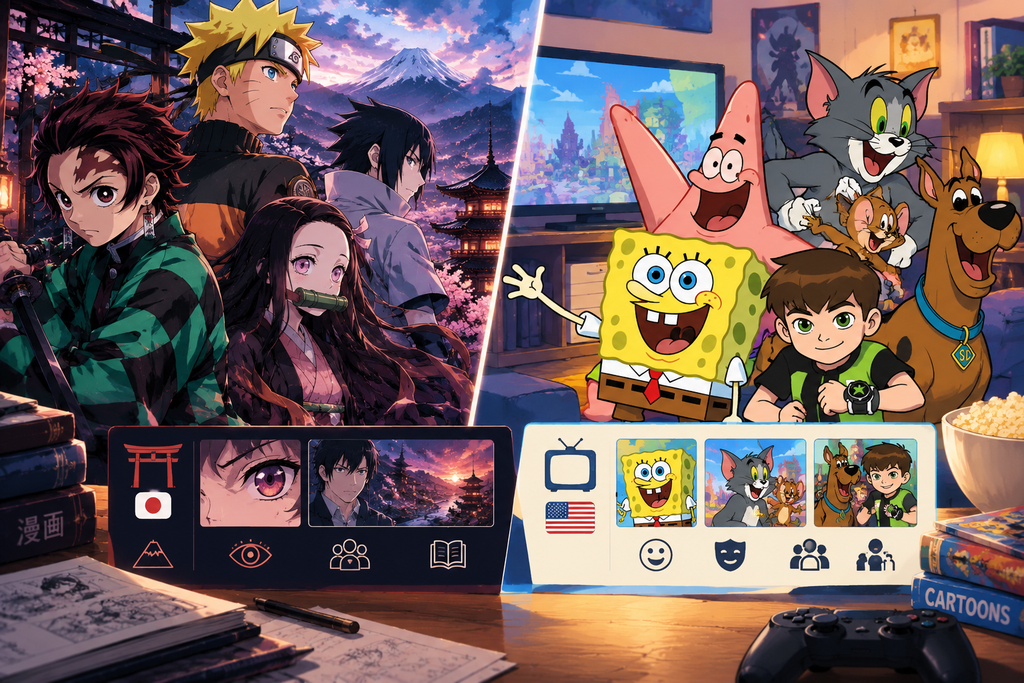
While both are forms of animation, the primary difference lies in origin, art style and target audience. Anime originates from Japan and features complex storylines, distinct exaggerated facial expressions and mature themes. Western cartoons generally focus on episodic comedy, simpler character designs and family friendly humor.
Anime is technically still a cartoon in the broadest sense of the word, since both are hand drawn or digitally animated content. The distinction people actually mean when they ask this question is cultural and stylistic, not a strict technical category.
Core Differences: Anime vs Western Cartoons
While both mediums share animated roots, anime and Western cartoons diverge significantly in cultural history, artistic execution and narrative depth. Anime relies on detailed character designs, serialized storytelling and limited frame techniques aimed at broad age groups, whereas Western cartoons historically prioritize simplified geometries, episodic comedy and younger audience appeal.
Origin, History and Cultural Influences
Japanese animation traces back to the early 20th century, with Astro Boy in 1963 widely credited as the show that established anime’s modern visual language on television. Western animation has its own separate lineage, stretching from early theatrical shorts to the television cartoons that dominated Saturday mornings for decades.
These two traditions developed largely independently for most of the 20th century, which is part of why their visual styles still feel so distinct today.
Cross cultural influence did eventually happen in both directions, with early anime pioneers openly citing Western animators like Disney as inspiration, even as the medium grew into something visually distinct.
Visual Art Styles & Character Expressions
Anime characters typically feature large expressive eyes, dynamic hair and detailed emotional cues drawn directly into the artwork. Western cartoons tend toward rounder, simpler shapes designed for quick recognition and broad comedic timing.
Neither approach is more advanced than the other; they are simply built around different storytelling priorities. While cartoons often lean into exaggerated physical comedy anime frequently emphasizes subtle emotional nuance a narrative style that extends directly into popular anime phone games and story driven mobile RPGs.
Animation Techniques (Limited Animation vs Traditional Cel)
Anime production has historically relied on limited animation, reusing frames and focusing movement on key moments to manage tight budgets and schedules. Western television cartoons developed their own version of limited animation too, though the visual results ended up looking quite different due to differing art styles.
Target Audience and Narrative Complexity
Anime spans every age demographic in Japan, from children’s shows to series aimed squarely at adults with complex, long running plots. Western cartoons have historically skewed younger, though shows like Avatar: The Last Airbender and Arcane have pushed that boundary with serialized, mature storytelling.
This demographic range is one reason anime resists easy categorization. A single streaming library can hold a lighthearted kids’ show right next to a psychologically dense drama, both technically falling under the same umbrella term.
What Counts as Anime?
The simplest working definition is animation produced in Japan, regardless of genre or art style. This means influence alone doesn’t qualify a show as anime, even when a cartoon clearly borrows visual techniques from Japanese animation.
Is Doraemon a Cartoon or Anime?
Doraemon is anime. It’s a long running Japanese series based on a manga, produced by Japanese studios, which places it firmly in the anime category despite its simple, child friendly art style.
Is Naruto an Anime or a Cartoon?
Naruto is anime. It originated as a Japanese manga before being adapted into a television series produced entirely by Japanese studios, checking every box that defines the category.
Is Avatar a Cartoon or Anime?
Avatar: The Last Airbender is a cartoon, produced by an American studio for Nickelodeon. It draws heavily on anime inspired art and pacing, which is exactly why so many viewers assume it’s Japanese, but production origin still places it in the Western cartoon category.
Is SpongeBob a Cartoon or Anime?
SpongeBob SquarePants is a cartoon, created and produced entirely in the United States by Nickelodeon. Its simple character designs and episodic comedy format are also textbook examples of traditional Western animation.
Why Are Gen Z Obsessed With Anime?

Anime’s popularity among younger viewers has grown dramatically in recent years. A Crunchyroll and National Research Group study of 29,000 entertainment consumers found that roughly 54 percent of Gen Z respondents identified as anime fans, putting it ahead of major franchises like the NFL in that age group.
Streaming access plays a huge role here. Platforms dedicated entirely to anime have made discovery far easier than it was for previous generations, who often relied on limited television blocks or imported physical media.
A separate Crunchyroll commissioned survey found that anime awareness among Gen Z sits close to universal, with only a small fraction of respondents saying they’d never heard of it. That level of cultural saturation would have been unthinkable even a decade ago.
Key Visual Tropes Unique to Anime
Iconic Facial Expressions (Sweat Drops, Vein Marks, Face Faults)
Anime has developed its own visual shorthand for emotion, including exaggerated sweat drops for embarrassment, popping vein marks for anger and simplified “chibi” faces for comedic moments. These tropes are instantly recognizable to longtime viewers and rarely appear in Western cartoons.
Cinematic Backgrounds and Environmental Framing
Anime frequently uses detailed, painterly backgrounds paired with dramatic camera angles borrowed from live action filmmaking. This creates a sense of scale and atmosphere that stands in contrast to the flatter, more graphic backgrounds typical of Western television cartoons.
Storytelling Dynamics: Episodic vs Serialized Plotlines
Western cartoons have traditionally favored episodic storytelling, where each episode resets by the credits and can be watched in any order. Anime leans much more heavily toward serialized arcs, where individual episodes build directly on previous ones toward a larger overarching story.
This isn’t an absolute rule in either direction. Modern Western animation increasingly embraces serialized storytelling, while plenty of anime still follows a lighter, episodic format aimed at younger audiences.
Streaming platforms have accelerated this blending further, since binge watching rewards serialized storytelling regardless of which country a show originated in.
Popular Examples: Classic Cartoons vs Iconic Anime
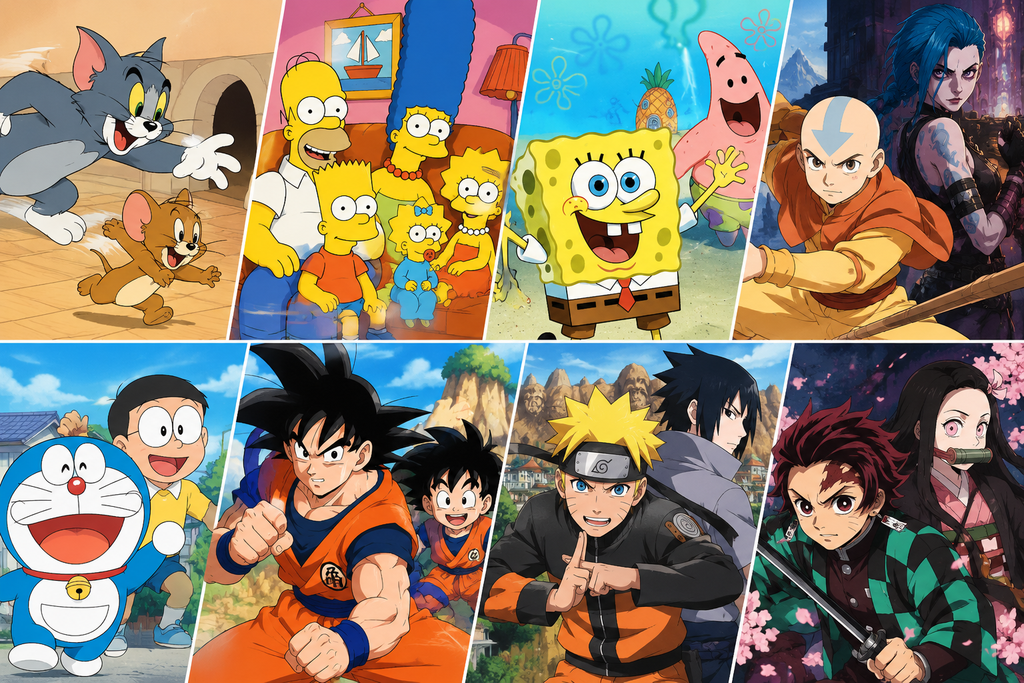
- Classic Western cartoons: Tom and Jerry, The Simpsons, SpongeBob SquarePants
- Modern serialized Western animation: Avatar: The Last Airbender, Arcane
- Long running anime classics: Doraemon, Dragon Ball
- Modern global anime hits: Naruto, Demon Slayer
Conclusion
Anime and cartoons aren’t really rivals, they’re two animation traditions that grew up on opposite sides of the world and developed their own visual languages. Origin is what technically separates them, while art style and storytelling pace are what most viewers actually notice first.
Understanding that distinction makes it much easier to place confusing shows correctly, whether that’s an anime inspired Western series or a simply drawn Japanese classic. Neither tradition is objectively superior, since they’re built around different creative goals from the ground up.
The real takeaway is that both mediums keep borrowing from each other more than ever, which is exactly why the line between them keeps getting blurrier every year.
FAQs
What’s the difference between anime and a cartoon?
Anime specifically refers to animation produced in Japan while cartoon is a broader term for animated content generally including Western shows.
Is anime basically a cartoon?
Technically yes since anime is a subset of animation, but the term anime specifically points to its Japanese origin and distinct visual style.
Which is better, cartoon or anime?
Neither is objectively better since each serves different storytelling goals and audience preferences.
Is anime safe for kids?
Some anime is made specifically for children, while other titles contain mature themes, so checking the age rating before watching matters.
Which came first, anime or cartoon?
Western animation predates modern anime by several decades, though both trace back to early 20th century experiments with hand drawn motion.
Is anime just a genre of cartoon?
This is a common misconception. Anime isn’t a genre at all it’s a category defined by country of origin and it spans nearly every genre that exists in animation.


Pingback: Best Anime Phone Games (Updated List): Worst vs Top Picks!
Pingback: Cartoon Anime Online: Amazing & Safe Streaming Guide 2026