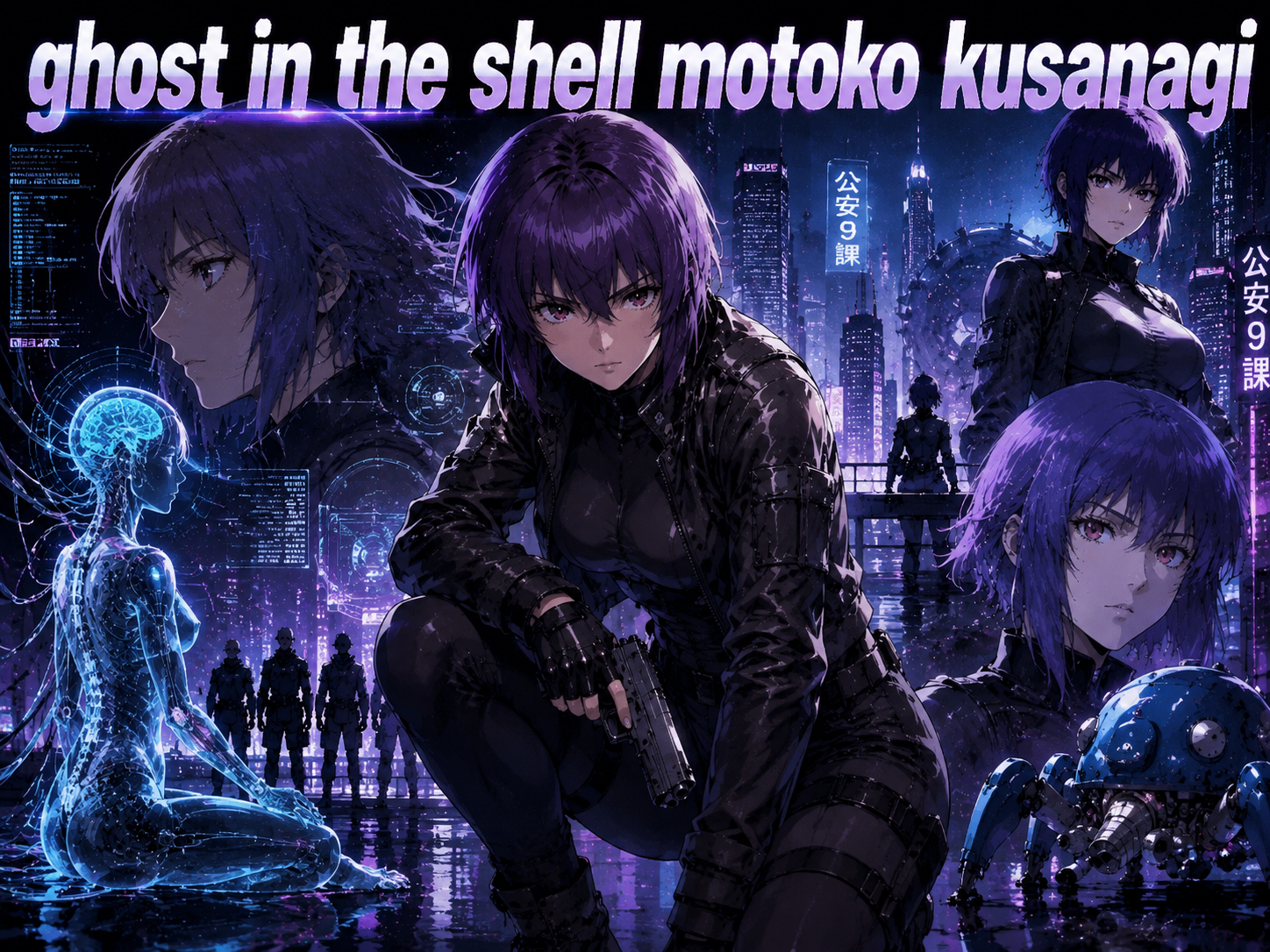
If you want to understand why Motoko Kusanagi is considered one of the most important characters in science fiction and anime history this guide covers everything from her origin to her philosophical significance across every major adaptation.
Major Motoko Kusanagi is not simply a strong female protagonist. In Ghost in the Shell, Motoko Kusanagi serves as a philosophical construct that forces audiences to question what consciousness, identity, and humanity actually mean when the body becomes entirely replaceable.
This guide covers her origin combat abilities fluid identity relationships across adaptations her evolution from the 1989 manga through SAC 2045 and her lasting impact on cyberpunk culture worldwide.
Who Is Major Motoko Kusanagi?
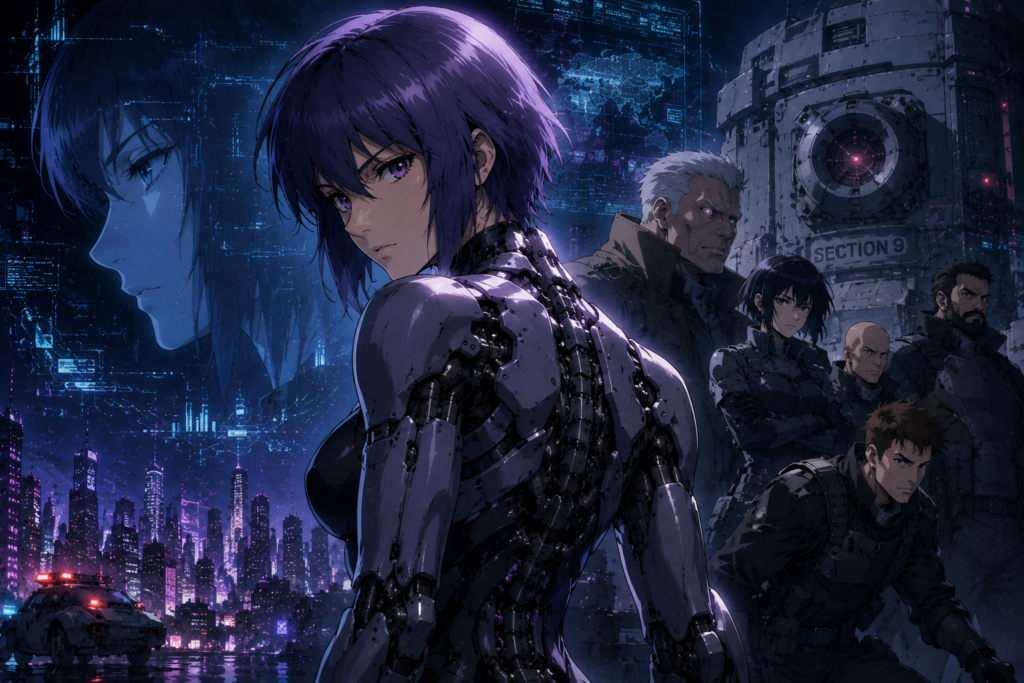
Motoko Kusanagi is a full body cyborg and elite counter terrorism operative who leads Public Security Section 9 in a near future Japan where cybernetic enhancement is standard across society.
Her human body was lost in a childhood accident leaving her consciousness transferred into a series of increasingly advanced prosthetic bodies manufactured by Megatech Body. The body she inhabits is not her identity her Ghost is.
She is called Major because of her military rank which she earned through exceptional tactical performance making her the operational commander of Section 9’s most sensitive assignments.
Cybernetic Body and Section 9 Leadership
Section 9 is Japan’s covert counter cyberterrorism unit operating outside standard law enforcement channels under Chief Daisuke Aramaki’s direction.
Motoko leads field operations personally rather than commanding from a distance which distinguishes her leadership style from typical command structures. Her direct engagement reflects both tactical necessity and her philosophical need to remain active within the physical world rather than retreating into pure digital existence.
Her full cybernetic body gives her capabilities beyond any human operative including physical strength far exceeding biological limits and the ability to interface directly with digital networks through her cyberbrain.
Human Ghost vs Machine Shell: The Core Philosophy
The Ghost vs Shell concept is the philosophical foundation of the entire franchise. Ghost refers to consciousness the accumulated memories experiences and personality that constitute identity. Shell refers to the physical body whether biological or cybernetic.
Motoko’s central existential question is whether a Ghost that has been copied modified and potentially duplicated across cybernetic hardware retains any authentic claim to individual identity or whether the concept of a continuous self becomes meaningless in a world of transferable consciousness.
This question distinguishes Ghost in the Shell from simpler robot narratives because Motoko is never presented as trying to become more human. She is questioning whether the category of human consciousness has any stable meaning at all.
Motoko Kusanagi Across Different Timelines and Adaptations
The Major appears across six distinct media versions each interpreting her character with different emphases and visual presentations while maintaining the Ghost vs Shell philosophical core.
The 1989 Manga vs 1995 Anime Film
Masamune Shirow’s original 1989 manga presents Motoko as expressive playful and occasionally irreverent a character who uses humor and personality to cope with the existential weight of her situation. The manga includes extensive philosophical footnotes that reveal Shirow’s genuine engagement with the questions the story raises.
Mamoru Oshii’s 1995 film adaptation transforms Motoko into a stoic introspective figure whose emotional restraint amplifies the philosophical loneliness of her position. The film’s Motoko speaks less and contemplates more creating one of anime cinema’s most meditative protagonists. The 1995 film is widely credited with establishing Ghost in the Shell’s international reputation and directly influencing The Matrix’s visual language and philosophical concerns.
Stand Alone Complex and SAC 2045 Evolution
Kenji Kamiyama’s Stand Alone Complex television series (2002 2005) presents Motoko as a balanced tactical leader who combines the manga’s personality with greater professional focus.
Her relationship with Batou in SAC carries genuine warmth suggesting a deep mutual respect that edges toward emotional dependency without ever becoming explicitly romantic. The Tachikoma AI tanks she interacts with serve as philosophical mirrors their developing consciousness echoing questions about her own identity.
SAC 2045 shifts to full 3D CGI animation and a post pandemic global economic collapse setting with Motoko operating as a mercenary before Section 9’s reconstitution. The visual and tonal shift divided audiences but maintained the franchise’s core philosophical commitments.
Motoko Kusanagi in Arise and Live Action 2017
Ghost in the Shell Arise (2013 2015) functions as a prequel origin story showing a younger Motoko establishing her independence from military control and assembling what will become Section 9.
Arise’s Motoko is more confrontational and less emotionally settled than her SAC counterpart reflecting a character still forming her identity rather than operating from an established philosophical position.
The 2017 Hollywood live action adaptation starring Scarlett Johansson generated controversy regarding casting decisions. The film simplified the philosophical complexity of the source material into a more conventional identity mystery narrative while retaining the visual aesthetic of Oshii’s 1995 film.
Personality Sexual Identity and Relationships
Motoko’s personality across adaptations consistently combines intellectual rigor with physical confidence and a dry wit that emerges most clearly in the manga and SAC versions.
Her identity across the franchise demonstrates what scholars describe as fluid cybernetic humanity a relationship with gender body and selfhood that is consciously chosen rather than biologically determined. She inhabits female presenting bodies by preference but the franchise frames this as aesthetic and philosophical choice rather than biological fact.
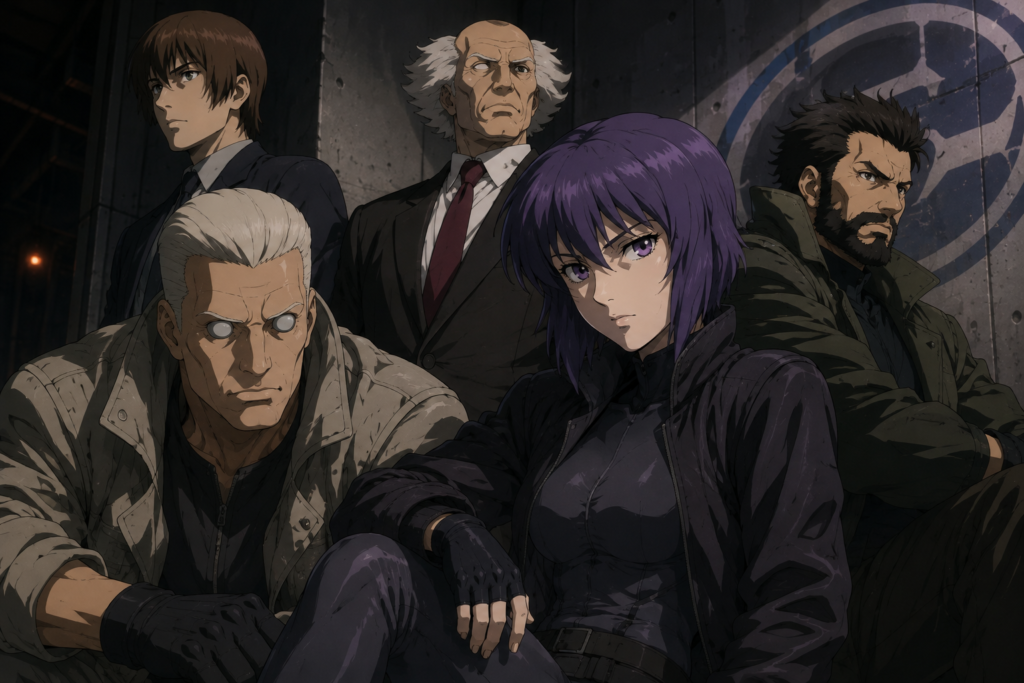
Her relationship with Batou is the franchise’s most emotionally significant connection characterized by mutual trust professional respect and an unspoken emotional bond that multiple adaptations approach differently without ever fully resolving.
Chief Aramaki represents a paternal authority figure whose trust in Motoko’s judgment defines Section 9’s operational culture. Togusa the only Section 9 member with a largely biological body serves as a philosophical counterpoint to Motoko’s full cybernetic existence.
Key Abilities Combat Gear and Cybernetics
Motoko’s cybernetic body provides capabilities that make her one of fiction’s most formidable tactical operators even by the standards of a society where cybernetic enhancement is widespread.
Core cybernetic capabilities:
- Thermoptic camouflage allowing near complete optical invisibility during operations
- Cyberbrain hacking allowing direct neural intrusion into connected targets
- Physical strength and durability far exceeding biological human limits
- Direct network interface without external hardware requirements
- Multiple simultaneous remote body operation in selected continuities
Her standard armament includes specialized firearms optimized for cybernetic targeting systems alongside elite hand-to-hand combat skills, making her as lethal as Karlach in close-quarters battle. This tactical versatility ensures she remains effective even without full cybernetic enhancement.
Impact and Legacy on Cyberpunk Culture
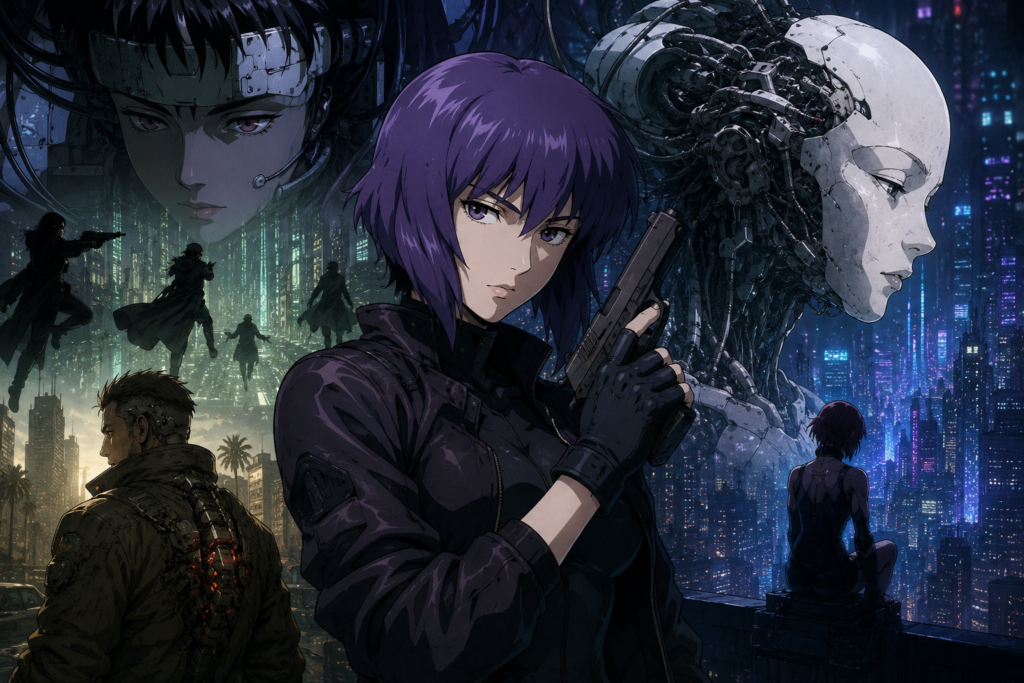
Major Motoko Kusanagi’s influence on science fiction extends far beyond the franchise itself, as Ghost in the Shell Motoko Kusanagi shaped how creators approach artificial consciousness, female protagonists, and philosophical sci fi across multiple media.
The Wachowski Sisters cited Ghost in the Shell’s 1995 film as a primary visual and philosophical reference for The Matrix specifically mentioning Motoko’s influence on Trinity’s character design and the film’s questions about constructed versus authentic reality.
Cyberpunk 2077’s character design and philosophical concerns about body modification and digital consciousness draw extensively from the conceptual framework Ghost in the Shell established through Motoko’s character arc.
According to academic research in the Journal of Japanese Studies, Ghost in the Shell leads philosophical discussions on artificial consciousness. This cybernetic archetype directly shaped character designs in every modern anime girls gacha game, where futuristic heroines explore posthuman identity.
Motoko’s significance lies not in being a powerful female character in a genre dominated by male protagonists but in being a character whose gender body and humanity are all simultaneously unstable categories that the narrative refuses to resolve with comforting certainty.
Conclusion
Major Motoko Kusanagi is one of fiction’s most philosophically sophisticated characters precisely because, in Ghost in the Shell Motoko Kusanagi raises questions about identity, consciousness, and humanity that remain genuinely unresolved across thirty five years of adaptations.
Her evolution from Shirow’s playful manga original through Oshii’s stoic film interpretation to SAC’s balanced tactical leader reflects not inconsistency but the genuine depth of questions that resist single definitive answers.
The best starting point for new audiences is Oshii’s 1995 film for philosophical depth followed by Stand Alone Complex for character development before exploring the manga and Arise for the full range of interpretations the character supports.
FAQs
Is Motoko Kusanagi completely a robot?
No Motoko is a cyborg retaining her human Ghost consciousness and memories within a fully cybernetic prosthetic body after a childhood accident destroyed her biological form.
Why is Motoko Kusanagi called Major?
Major is her military rank earned through exceptional service reflecting her command position as Section 9’s field operations leader rather than a personal name or title.
What happens to Motoko at the end of the 1995 film?
Her consciousness merges with the Puppetmaster AI creating a new hybrid entity that transcends both human and artificial boundaries before departing to explore an expanded digital existence.
What is the difference between Motoko’s Ghost and Shell?
Ghost refers to consciousness memories personality and selfhood. Shell refers to the physical cybernetic body. The franchise explores whether Ghost authenticity survives when Shell becomes entirely artificial and replaceable.
Was Motoko Kusanagi ever human?
Yes She was born human and suffered a childhood accident requiring full body cybernetic replacement. Her human Ghost consciousness and memories persists within successive cybernetic bodies throughout the franchise.
Is it true that Ghost in the Shell is only a Japanese franchise with limited Western relevance?
This is a significant misconception. Ghost in the Shell directly influenced The Matrix Cyberpunk 2077 and numerous Hollywood productions. It is cited more frequently than any other anime work in Western academic philosophy literature addressing artificial consciousness.